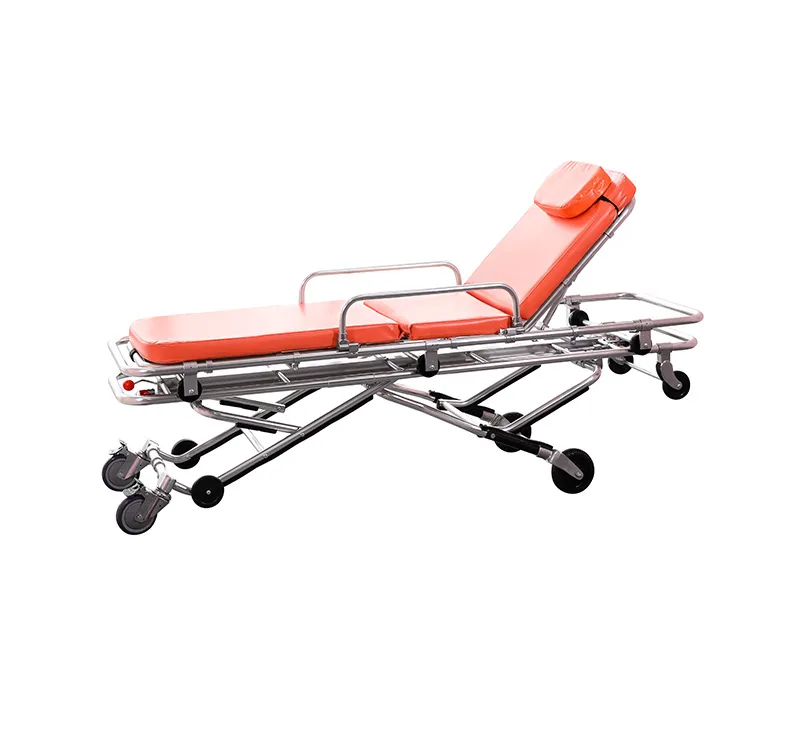
An ambulance stretcher is a patient transport device designed for moving patients during emergency response and ambulance-to-hospital transfers. Unlike a general ward stretcher, an ambulance stretcher is designed around the requirements of loading, securing and transporting a patient inside an ambulance.
Typical features may include an adjustable backrest, folding or collapsible undercarriage, side rails, patient restraint belts, wheels, brakes and an ambulance locking mechanism.
The exact configuration varies by model, so ambulance compatibility should always be confirmed before purchase.
The ambulance stretcher price in Kenya varies according to construction, loading mechanism, adjustability, weight capacity, accessories and ambulance compatibility.
Current Kenya listings include:
A current Nairobi listing shows an ambulance stretcher at KSh 75,000, while another current Kenya listing gives KSh 78,000. Nairobi marketplace listings also show ambulance stretchers around KSh 70,000–80,000.
These are current listing examples rather than a fixed nationwide price.
If you want to buy an ambulance stretcher in Nairobi, confirm that the selected model fits the ambulance before ordering.
Important points to check include:
Overall stretcher length and width
High and low height
Loading height
Undercarriage dimensions
Folding mechanism
Ambulance locking system
Wheel configuration
Braking system
Patient restraints
Side rails
Backrest adjustment
Maximum safe working load
IV-pole provision
Oxygen-cylinder holder
Kenya ambulance procurement specifications specifically require features such as heavy-duty aluminium construction, side rails, braking on at least two wheels, adjustable backrest, IV-pole provision and an integrated oxygen-cylinder holder.
An adjustable ambulance stretcher for sale in Kenya can provide different patient positions during transport.
Depending on the model, adjustment may include:
Adjustable backrest
Adjustable stretcher height
Folding undercarriage
Low loading position
High working position
Trendelenburg on selected advanced models
One current Kenya ambulance stretcher listing specifies a high position of approximately 190 × 55 × 92 cm and a low position of approximately 190 × 55 × 26 cm, with a maximum back angle of 70°.
These measurements are model-specific and should not be treated as universal ambulance-stretcher dimensions.
When selecting an ambulance stretcher supplier in Kenya, ask for a quotation containing the exact manufacturer and model rather than relying only on a product name.
A professional quotation should specify:
Stretcher dimensions
Weight
Safe working load
Frame material
Side-rail design
Wheel size
Brake system
IV pole
Oxygen holder
Mattress
Warranty
Delivery and installation
For ambulance operators and institutional buyers, vehicle compatibility is particularly important because ambulance interiors, loading heights and securing systems differ.
An emergency patient transport stretcher in Kenya is designed to help emergency teams move patients from accident scenes, homes, clinics or other locations into an ambulance and subsequently to a healthcare facility.
The stretcher should allow:
Secure patient positioning
Controlled movement
Easy steering
Safe loading
Safe unloading
Patient restraint
Access to the patient during transport
A current Kenya ambulance-stretcher listing describes adjustable back support, safety side rails, patient restraint belts, smooth-rolling wheels and height adjustment.
An adjustable backrest allows the patient's upper body to be positioned according to the stretcher design and clinical requirements.
A current ambulance stretcher specification lists a maximum backrest angle of 70°, while Kenyan hospital procurement specifications for ambulance stretchers require an adjustable backrest.
The exact adjustment range varies by model.
Side rails help provide a barrier along the sides of the patient platform during movement.
Common designs include:
Folding side rails
Collapsible side rails
Metal rails
Aluminium rails
Adjustable rails
A current Kenya ambulance stretcher listing specifies adjustable side rails, while Kenyan procurement specifications require side rails on ambulance patient stretchers.
Side rails should be checked before every use to ensure they operate and lock correctly.
Patient restraint belts help secure the patient during ambulance transport.
Kenyan ambulance procurement specifications specifically require safety belts on the stretcher surface.
When buying, confirm:
Number of straps
Strap adjustment
Buckle design
Attachment points
Ease of cleaning
Replacement availability
Restraints should be used according to the manufacturer's instructions and applicable patient-transport procedures.
Many ambulance stretchers use a folding undercarriage that allows the stretcher to be lowered and loaded into an ambulance.
A current Nairobi marketplace listing describes a high-strength aluminium-alloy ambulance stretcher with mechanically folding legs operated using handles at one end, together with security devices for locking the stretcher inside the ambulance.
The exact loading mechanism varies between ambulance-stretcher models.
A self-loading ambulance stretcher is designed to make ambulance loading and unloading easier by using a folding undercarriage or dedicated loading mechanism.
Current Nairobi marketplace results include self-loading ambulance stretchers around KSh 70,000, although specifications vary by listing.
Before purchasing, confirm whether “self-loading” refers to a mechanical folding-leg design or a more advanced assisted loading system.
Aluminium alloy is commonly used in ambulance stretchers because it can provide a relatively lightweight frame while maintaining structural strength.
Kenyan procurement specifications call for a high-strength/heavy-duty aluminium alloy ambulance patient stretcher.
One current Kenya listing gives a net weight of approximately 36.8 kg, gross weight of approximately 43 kg and a stated load bearing capacity below 159 kg for its particular model.
These figures are model-specific.
An oxygen-cylinder holder can be useful when a patient requires oxygen during transport.
Kenyan ambulance procurement specifications require an integrated oxygen-tank holder capable of supporting at least a 1.36 m³ oxygen cylinder for the specified ambulance stretcher.
If an oxygen holder is important for your ambulance, confirm:
Cylinder size compatibility
Holder position
Locking mechanism
Cylinder restraint
Accessibility during transport
Do not assume that every ambulance stretcher includes an oxygen holder.
Some ambulance stretchers provide an IV-pole provision so that intravenous therapy can continue while the patient is transported.
Kenyan ambulance stretcher procurement specifications include provision for an IV pole.
When requesting a quotation, specify whether the IV pole is included or supplied separately.
Reliable wheels and brakes are essential for manoeuvring and securing an ambulance stretcher.
Important features include:
Heavy-duty castors
Smooth rolling
Directional control
Stable wheelbase
Suitable wheel diameter
Secure undercarriage
Kenyan procurement specifications require braking on at least two wheels, while more advanced patient stretchers may use central-locking systems.
Ambulance stretchers are used throughout the emergency patient-transfer pathway.
Potential applications include:
Ambulance transport
Accident and emergency
Inter-facility transfers
Hospital admission
Referral transfers
Emergency response
Patient transfer from ambulance to emergency department
The ambulance stretcher should be compatible with the ambulance and should not be selected solely because it is described as a “hospital stretcher.”
Although both are used to transport patients, their intended applications differ.
If the stretcher will be used in an ambulance, prioritize vehicle compatibility and the manufacturer's intended application.
Load capacity should be confirmed from the manufacturer's specification.
Current examples vary. One Kenya ambulance stretcher listing specifies a load-bearing capacity of less than 159 kg, while other ambulance-stretcher designs may have different ratings.
Do not assume that a larger-looking stretcher has a higher safe working load.
For institutional procurement, ask suppliers to state the maximum safe working load clearly in the quotation.
Before buying an ambulance stretcher in Kenya, consider:
Measure the ambulance's internal length, width, loading height and securing/mounting arrangement.
Confirm whether you require folding legs, self-loading capability or another loading system.
Check the high and low positions and confirm that the stretcher fits through the ambulance rear or side doors.
Look for appropriate side rails and patient restraint belts.
Confirm the backrest adjustment range.
Check wheel size, manoeuvrability and braking arrangements.
Choose a stretcher with a manufacturer-rated safe working load suitable for the intended patient population.
If oxygen is routinely carried during transport, verify cylinder-holder compatibility.
Confirm whether an IV pole is required and whether it is included.
Check the mattress material, thickness and cleanability.
A lighter stretcher may be easier for crews to handle, but construction and safe working load must also be considered.
Confirm warranty, replacement parts, repairs and after-sales support.
Only trained ambulance or healthcare personnel should operate an ambulance stretcher.
A general workflow is:
Inspect the stretcher before use.
Check wheels, brakes, side rails and restraints.
Verify that the folding/loading mechanism is functioning correctly.
Confirm that the stretcher can be securely locked into the ambulance.
Position the stretcher according to the applicable patient-transfer procedure.
Transfer and secure the patient using the appropriate restraints.
Confirm that side rails are secured.
Check IV lines, oxygen tubing and monitoring equipment.
Load the stretcher according to the stretcher and ambulance manufacturer's procedures.
Engage the ambulance locking mechanism.
Confirm the stretcher is secure before the vehicle moves.
Follow the ambulance service's patient-monitoring and transport procedures.
The manufacturer's instructions and local clinical protocols should always take precedence.
Regular inspection is essential because ambulance stretchers are repeatedly loaded, unloaded, cleaned and transported.
Inspect:
Frame
Folding legs
Ambulance mounting points
Wheels
Brakes
Backrest mechanism
Fasteners and joints
Check particularly for damage caused by repeated loading and unloading.
A stretcher with defective brakes, damaged locking components, unstable side rails or structural damage should be removed from service until inspected and repaired appropriately.
Current Kenya listings show ambulance stretchers around KSh 70,000–80,000. Examples include KSh 75,000, KSh 78,000 and KSh 80,000. More advanced emergency stretcher trolleys can cost more.
Ambulance stretchers are available from medical-equipment suppliers and specialist hospital-furniture dealers in Nairobi. Before ordering, confirm stock, exact specifications, ambulance compatibility, warranty and delivery terms.
An ambulance stretcher is designed specifically for loading into and securing inside an ambulance. A general hospital stretcher is primarily designed for movement within a healthcare facility and may not have a compatible folding undercarriage or ambulance locking system.
Many ambulance stretchers provide adjustable backrests and may have adjustable high and low positions. The exact adjustment features vary by model.
Yes. Ambulance stretchers use wheels or castors to allow patient movement and loading. Wheel configuration and braking systems vary by model.
Many ambulance stretchers include patient restraint belts. Kenyan ambulance procurement specifications specifically require safety belts.
Selected models do. Kenyan procurement specifications include an integrated oxygen-cylinder holder for the specified ambulance stretcher. Confirm cylinder compatibility before purchase.
Current examples are approximately KSh 75,000–80,000 for standard ambulance stretchers, although the price can increase for more advanced loading, positioning or emergency features.
No. Ambulance interiors and mounting systems differ. Confirm the stretcher's dimensions, loading height, undercarriage and locking mechanism against the specific ambulance before purchasing.
The required capacity depends on the patient population and manufacturer's specification. Current models have different ratings, so the safe working load should be confirmed from the exact product documentation.
Specifications should be confirmed against the exact stretcher model and ambulance before purchase.
When requesting a quotation for an ambulance stretcher in Kenya, provide:
Ambulance make/model or conversion details
Internal loading dimensions
Required stretcher dimensions
Mounting/locking system
Required load capacity
Adjustable backrest requirement
Patient restraint belts
Quantity required
Delivery location
Warranty requirements
For ambulance operators, hospitals, county health facilities and NGOs, request the supplier to confirm compatibility with the actual ambulance before placing the order.
These other products might interest you
Allow the use of cookies from this website on this browser?
We use cookies to provide improved experience on this website. You can learn more about our cookies and how we use them in our Cookie Policy.