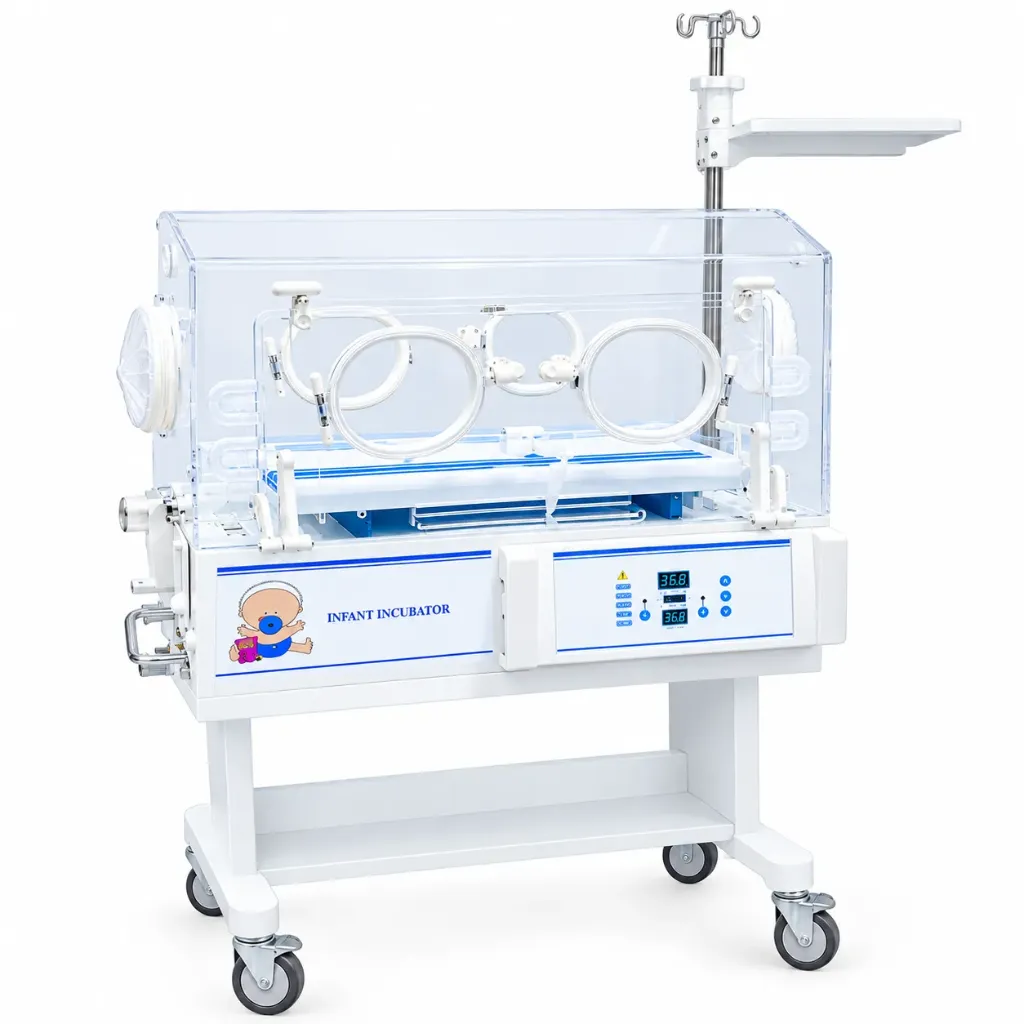
An infant incubator is specialized neonatal medical equipment designed to provide a controlled environment for newborn babies who require additional support with temperature regulation and clinical observation. It creates an enclosed environment where temperature and, depending on the model, humidity can be controlled and monitored.
An infant incubator in Kenya is commonly used in neonatal intensive care units (NICUs), maternity hospitals, newborn stabilization units and pediatric facilities. Current Kenyan suppliers list infant incubators with features such as controlled temperature and humidity, digital displays, alarms, transparent canopies and access ports for clinical care.
An infant incubator, also known as a baby incubator or neonatal incubator, is a medical device that provides a controlled microenvironment for newborns who need additional thermal support and monitoring.
Unlike an open radiant warmer, an incubator provides an enclosed environment. Depending on the model, it can regulate temperature and humidity while allowing healthcare professionals to observe and access the baby through designated access doors and ports.
Infant incubators are particularly relevant in neonatal care for premature, low-birth-weight or medically vulnerable newborns.
Features vary between manufacturers and models, but a baby incubator may include:
Controlled air-temperature regulation
Skin-temperature monitoring
Adjustable humidity
Digital temperature display
Temperature and system alarms
Transparent acrylic canopy
Access doors and hand ports
Adjustable infant mattress
Mattress tilting mechanism on selected models
Removable humidity reservoir
Oxygen inlet on selected models
Wheels or castors for mobility
Integrated or optional phototherapy
Self-check and fault alarms
Adjustable temperature settings
For example, a Kenyan-listed infant incubator includes computer-controlled air temperature, self-check alarms, a removable humidity reservoir and optional phototherapy.
A baby incubator in Kenya can be used in different healthcare settings depending on the facility's neonatal-care requirements.
Common applications include:
Neonatal intensive care units
Maternity hospitals
Newborn stabilization units
Pediatric hospitals
County and referral hospitals
Private medical centres
Teaching hospitals
Specialized neonatal units
When purchasing neonatal equipment, healthcare facilities should consider not only the initial price but also maintenance, staff training, spare parts, power requirements and technical support.
A newborn incubator provides a controlled environment for babies who require additional thermal support and monitoring.
Depending on the model, the incubator may provide:
Temperature control:
Helps maintain the programmed thermal environment around the infant.
Humidity control:
Available on many neonatal incubators and particularly relevant when managing infants who require controlled humidity.
Monitoring:
Digital displays and alarm systems can help healthcare professionals monitor operating conditions.
Access:
Access doors and ports allow clinical procedures while maintaining the enclosed environment.
Observation:
The transparent canopy allows healthcare personnel to observe the infant without continuously opening the enclosure.
A neonatal incubator in Kenya should be selected according to the clinical requirements of the newborn unit and the specifications of the particular model.
Important considerations include:
Air and skin temperature modes
Humidity control
Alarm functions
Temperature accuracy
Infant-bed dimensions
Mattress adjustment
Access ports
Cleaning requirements
Power consumption
Backup-power arrangements
Availability of replacement parts
Technical servicing
Warranty and staff training
Kenyan hospital procurement documents also demonstrate the need for ongoing availability of incubator components such as temperature modules, access doors, fan motors, humidifier chambers and other service parts.
An infant incubator and radiant warmer are both used in neonatal care, but their designs are different.
Feature
Infant Incubator
Radiant Warmer
Environment
Enclosed
Open
Heat source
Controlled internal heating system
Overhead radiant heat
Humidity
Available on many models
Generally not controlled
Infant access
Through ports and doors
Open access
Clinical use
Ongoing controlled neonatal care
Procedures, assessment and active care
Protection from drafts
Enclosed environment
Limited
Phototherapy
Available on selected models
These devices are complementary rather than interchangeable, and the appropriate equipment depends on the baby's condition and the clinical procedure being performed.
Infant incubators should be operated by trained healthcare professionals according to the manufacturer's instructions and the facility's neonatal-care protocols.
A general operating process may include:
Inspect the incubator before use.
Clean and prepare the infant compartment according to infection-control procedures.
Confirm the electrical connection and backup-power arrangements.
Switch on and allow the system to reach the required operating conditions.
Set the appropriate temperature and humidity parameters according to clinical instructions.
Position the newborn correctly on the mattress.
Attach temperature sensors where required.
Confirm that alarms and monitoring systems are functioning.
Monitor the infant and equipment continuously.
Clean and disinfect the unit according to the manufacturer's recommendations after use.
Exact settings should always be determined by qualified clinical staff based on the baby's condition and the specific incubator model.
An infant incubator is medical equipment and should only be operated by appropriately trained personnel.
Important precautions include:
Follow the manufacturer's operating instructions.
Check the incubator before each use.
Verify that temperature sensors are correctly positioned.
Monitor the infant regularly.
Do not ignore equipment alarms.
Keep access doors and ports properly closed when not in use.
Maintain appropriate cleaning and infection-control procedures.
Check the humidity system where applicable.
Ensure adequate electrical and backup-power arrangements.
Schedule preventive maintenance and calibration as recommended.
Use only compatible accessories and replacement parts.
Because neonatal equipment can be critical to patient care, facilities should also maintain appropriate technical support and essential spare parts.
The infant incubator price in Kenya varies according to the model, temperature-control system, humidity functions, alarm systems, phototherapy integration and other specifications.
Current Kenyan listings provide several price examples:
BIN-3000A 4-hole infant incubator: about KSh 225,000.
Standard BIN-3000B infant incubator: about KSh 325,000.
BIN-3000B(S) incubator with phototherapy: about KSh 295,000.
Another Kenyan supplier lists an infant incubator at approximately KSh 240,000.
Mediplug lists an infant/baby incubator at approximately KSh 250,000.
Medocal lists an infant incubator at approximately KSh 265,000.
Other current Kenyan listings reach KSh 300,000–370,000, depending on the equipment configuration.
Therefore, a practical current listing range for many infant incubators in Kenya is approximately KSh 225,000–370,000, while specialized or higher-specification equipment may cost more. Prices can change according to supplier, model, accessories and installation requirements.
When buying a baby incubator in Kenya, compare the complete specification rather than price alone.
Consider:
Temperature-control method
Air and skin temperature monitoring
Alarm and safety systems
Canopy and access-port design
Phototherapy availability
Power requirements
Backup-power requirements
Ease of cleaning
Spare-parts availability
Installation and commissioning
Warranty
Technical support
Staff training
For hospitals and neonatal units, the equipment should match the facility's intended level of newborn care.
Check whether the unit provides air-temperature control, skin-temperature monitoring or both.
If humidity control is required, confirm the available range, reservoir design and monitoring functions.
Look for appropriate alarms for temperature deviations, sensor problems, power failure and other system faults.
Access doors and hand ports should allow healthcare professionals to perform necessary procedures while maintaining the controlled environment.
Consider how easily the canopy, mattress, reservoir and internal surfaces can be cleaned.
Neonatal units should have appropriate backup-power arrangements for critical equipment.
Confirm availability of service engineers, replacement parts, calibration and preventive maintenance.
Some models offer integrated or optional phototherapy, mattress tilting and other neonatal-care functions.
Specification
Typical/Model-Dependent Information
Equipment type
Infant/neonatal incubator
Enclosed controlled environment
Temperature control
Air and/or skin servo control, depending on model
Display
Digital display on many models
Alarm system
Temperature, sensor and system alarms depending on model
Canopy
Transparent acrylic or equivalent
Access
Mattress
Adjustable/tilting on selected models
Integrated or optional on selected models
Oxygen inlet
Power supply
Model-dependent
Mobility
Castors/wheels on many models
Intended setting
NICU, maternity, newborn and pediatric units
Exact technical specifications should be confirmed from the manufacturer's datasheet before purchase.
An infant incubator is neonatal medical equipment that provides a controlled environment for newborns requiring additional thermal support and monitoring.
Current Kenyan listings show infant incubators from approximately KSh 225,000 to KSh 370,000 for several models, with some specialized equipment costing more.
A baby incubator is used to provide a controlled environment for newborns who need additional temperature regulation, humidity management and clinical monitoring.
No. An incubator provides an enclosed controlled environment, while a radiant warmer provides heat from an overhead source in an open infant-care area.
Many neonatal incubators include adjustable humidity control, although the exact functionality depends on the model.
Yes. Some models incorporate or support phototherapy, while others are designed for incubation only. Current Kenyan listings include incubators with integrated phototherapy.
An infant incubator should be operated by trained healthcare professionals following the manufacturer's instructions and the facility's neonatal-care protocols.
Product: Infant Incubator
Category: Neonatal & Maternity Equipment
Alternative names: Baby Incubator, Neonatal Incubator, Newborn Incubator
Application: Controlled neonatal care and thermal support
Common settings: NICUs, maternity hospitals, newborn units, pediatric hospitals and stabilization units
Temperature control: Model-dependent
Humidity control: Model-dependent
Monitoring: Digital display and alarms on many models
Phototherapy: Available on selected models
Availability: Kenya
Price: Model and configuration dependent
These other products might interest you
Allow the use of cookies from this website on this browser?
We use cookies to provide improved experience on this website. You can learn more about our cookies and how we use them in our Cookie Policy.