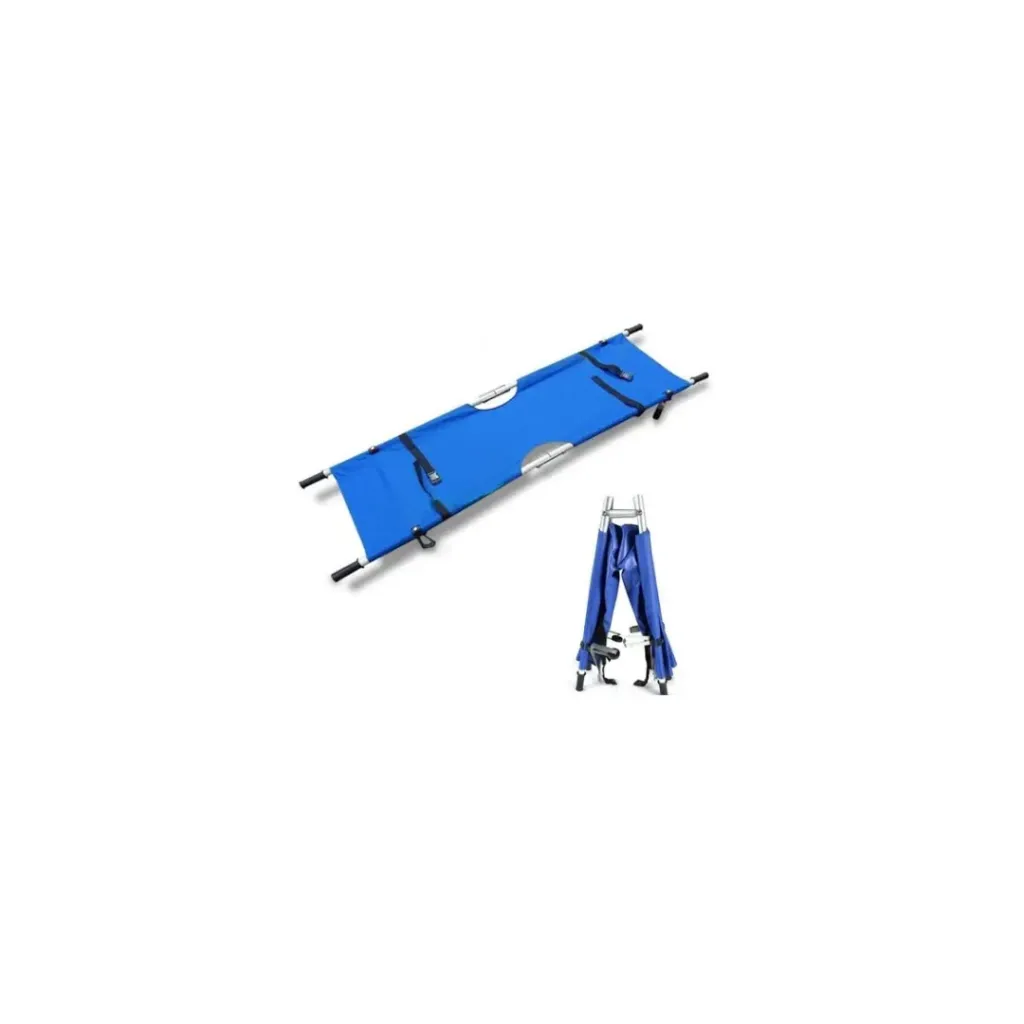
An emergency scoop stretcher is a trauma patient-transfer device designed to help move injured patients while minimizing unnecessary movement. Unlike a conventional one-piece stretcher, a scoop stretcher separates longitudinally into two sections that can be positioned around the patient and then locked together.
This split stretcher or clamshell stretcher design can be particularly useful when moving patients with suspected spinal or musculoskeletal injuries where minimizing movement during transfer is important.
Scoop stretchers are commonly used by emergency medical teams, ambulance services, hospitals, rescue teams and other trained responders.
The emergency scoop stretcher price in Kenya varies according to material, adjustable length, locking mechanism, load capacity and accessories.
Current Kenya listings provide these examples:
The KSh 28,000 Maesio listing describes an adjustable split-apart scoop stretcher made from aluminium alloy. Doctor Ally currently lists a medical scoop stretcher at KSh 25,000, while Generation Space lists an aluminium scoop model at KSh 59,520.
These are current listing examples rather than a fixed nationwide market price.
If you want to buy a scoop stretcher in Nairobi, confirm the exact model and specifications before ordering.
A suitable scoop stretcher should be evaluated according to:
Split or clamshell design
Adjustable length
Locking mechanism
Material
Maximum safe working load
Patient restraint straps
Compatibility with immobilization equipment
Storage requirements
Cleaning requirements
Warranty and replacement parts
Several medical-equipment suppliers operate in Nairobi, so institutional buyers should request a quotation identifying the exact model, accessories and warranty.
An adjustable scoop stretcher for sale in Kenya allows the stretcher length to be changed to accommodate different patient sizes.
The current Maesio model is described as having an adjustable length and two-piece split-apart design.
Another current Kenya listing describes its scoop stretcher as lightweight, adjustable and made from aluminium, with a locking mechanism and foldable design.
Adjustment ranges differ between models, so buyers should request the manufacturer's exact minimum and maximum length.
When choosing a scoop stretcher supplier in Kenya, consider both product specifications and after-sales support.
Ask the supplier to confirm:
Manufacturer and model
Length range
Number of sections
Restraint straps
Padding
Foldability
Compatibility with other immobilization equipment
Warranty
Replacement parts
Delivery arrangements
For hospitals, ambulance operators, NGOs and rescue organisations, a formal quotation is preferable to a generic product description.
A trauma patient scoop stretcher in Kenya is intended for trained responders managing patient transfers where minimizing movement is important.
The split design allows the two sections to be positioned from either side of the patient rather than requiring the entire stretcher to be slid underneath the patient.
Current Kenya product descriptions specifically identify scoop stretchers for trauma, fractures and serious injuries.
A scoop stretcher should be used as part of an appropriate trauma-management procedure by trained personnel. It does not replace clinical assessment or other immobilization equipment when those are indicated.
A split stretcher is another name commonly used for a scoop stretcher because the device separates into two longitudinal sections.
Current Kenya price examples include:
KSh 25,000 – medical scoop stretcher
KSh 28,000 – adjustable emergency scoop stretcher
KSh 35,000 – aluminium scoop stretcher
KSh 59,520 – scoop-type aluminium stretcher
The actual price depends on the design, material, load rating, accessories and supplier.
Scoop stretchers are particularly useful in situations where rescuers need to move an injured person while limiting unnecessary handling.
Potential applications include:
Road traffic accidents
Sports injuries
Workplace accidents
Suspected fractures
Emergency department transfers
Ambulance transfers
Rescue operations
Disaster response
Confined-space patient extraction
The exact clinical application should be determined by trained emergency personnel.
Many scoop stretchers use aluminium alloy because it can provide a combination of low weight and structural strength.
A current Kenya listing specifies an industrial-grade aluminium alloy scoop stretcher with a maximum load capacity of 160 kg. It also gives a normal length of 166 cm and extended length of 203 cm for that particular model.
These specifications are model-specific and should not be assumed for every aluminium scoop stretcher.
Adjustable length is useful when the same scoop stretcher needs to accommodate patients of different heights.
The adjustment mechanism should be checked before use to ensure that the sections are securely locked at the selected length.
The current Maesio product is described as having adjustable length, while Doctor Ally similarly identifies its scoop stretcher as length adjustable.
A scoop stretcher depends on its locking mechanism to join the two sections securely after positioning.
Before lifting a patient, trained personnel should verify that all required locks are properly engaged according to the manufacturer's instructions.
Inspect the locking mechanisms regularly for:
Damage
Excessive wear
Difficulty engaging
Loose fittings
Corrosion
Deformation
A stretcher with a defective locking mechanism should not be used until appropriately inspected.
Patient restraint straps can help maintain the patient's position during transport.
Some models include straps as standard, while others may require separate accessories.
The Generation Space aluminium scoop stretcher, for example, specifies heavy-duty safety straps, while the Nairobi marketplace listing also describes patient restraint straps.
Straps should be used according to the manufacturer's instructions and the applicable patient-handling procedure.
A scoop stretcher may form part of an ambulance or emergency-response equipment inventory.
Its compact split design can be useful when transferring patients from accident scenes or other difficult locations.
However, a scoop stretcher should not automatically be considered a substitute for an ambulance stretcher or stretcher trolley. The equipment serves different purposes.
If you are purchasing equipment specifically for an ambulance, confirm:
Vehicle storage dimensions
Stretcher compatibility
Patient restraint requirements
Maximum load
Folded dimensions
Applicable ambulance equipment requirements
Hospitals may keep scoop stretchers in:
Emergency departments
Trauma units
Ambulance receiving areas
Operating theatres
Accident and emergency rooms
Rescue teams
Critical patient-transfer areas
The equipment should be readily accessible and routinely inspected so that it is available when needed.
A scoop stretcher and patient stretcher trolley have different primary functions.
Choose the equipment according to the intended patient-transfer procedure rather than treating the products as interchangeable.
Before buying an emergency scoop stretcher in Kenya, consider:
Confirm that the stretcher separates into two sections and that both sections can be positioned correctly around the patient.
Check the minimum and maximum length and whether the adjustment accommodates the intended patient population.
Aluminium alloy is common, but verify the actual material specification.
Check the manufacturer's stated safe working load. Do not estimate capacity from the appearance of the frame.
Confirm that the joining mechanisms operate smoothly and securely.
Check whether patient restraint straps are included and whether replacements are available.
Determine whether padding is included or available separately.
Check folded or separated dimensions if the stretcher will be stored in an ambulance or rescue vehicle.
Confirm that the material and surface finish are compatible with the healthcare facility's approved cleaning and disinfection procedures.
For institutional procurement, confirm warranty coverage and replacement parts.
A scoop stretcher should be operated by trained emergency or healthcare personnel following the manufacturer's instructions and the applicable trauma protocol.
A general process is:
Inspect the scoop stretcher before use.
Check the frame, hinges and locking mechanisms.
Confirm the required length setting.
Separate the two sections.
Position the sections around the patient as directed by the applicable clinical procedure.
Join and lock the sections securely.
Apply appropriate patient restraints.
Confirm that all locks and straps are secure before lifting.
Coordinate the lift and transfer among the responding team.
Transfer the patient to the appropriate destination or receiving device.
Follow the applicable protocol for continued immobilization or transfer.
The exact procedure depends on the patient's condition, the equipment and the clinical protocol. A scoop stretcher should not be used as a substitute for professional trauma assessment.
Inspect the stretcher regularly, particularly when it forms part of emergency-response equipment.
Check:
Frame
Hinges
Locking mechanisms
Length-adjustment mechanism
Straps
Buckles
Surface condition
Cracks or deformation
Clean and disinfect the stretcher according to the manufacturer's instructions and the facility's infection-control procedures.
Do not use a scoop stretcher if a critical locking component is damaged or cannot be securely engaged.
Current Kenya listings show scoop stretcher prices of approximately KSh 25,000–59,520. Examples include KSh 25,000 for a medical scoop stretcher, KSh 28,000 for an emergency scoop stretcher, KSh 35,000 for an aluminium model, and KSh 59,520 for a scoop-type aluminium stretcher.
Scoop stretchers are available from medical-equipment suppliers in Nairobi. One current supplier listing specifically offers a medical scoop stretcher at KSh 25,000, while other Nairobi listings offer aluminium models.
A scoop stretcher is a split patient-transfer device that separates into two sections and can be positioned around a patient before being locked together. It is also called a clamshell or split stretcher.
It is primarily used for transferring trauma patients when minimizing unnecessary movement is important. Applications include suspected fractures, serious injuries, accident scenes and emergency rescue.
Many scoop stretchers have adjustable length. Current Kenya listings from Maesio and Doctor Ally both describe adjustable-length designs.
Aluminium alloy is common. Current Kenya listings include aluminium-alloy scoop stretchers, although the exact alloy and construction vary by model.
In many product listings, the terms refer to the same basic design. A split stretcher separates into two longitudinal sections that can be positioned around the patient and joined underneath or around them.
Some models include patient restraint straps, while the exact configuration varies. Confirm whether straps are included with the model being purchased.
Use the manufacturer's stated safe working load. For example, one current aluminium scoop stretcher specifies a maximum capacity of 160 kg, while other models may have different ratings.
Not necessarily. A scoop stretcher and spinal board have different designs and uses. The appropriate equipment should be selected by trained emergency personnel according to the patient's condition and applicable trauma protocol.
Specifications should be confirmed against the exact product model and supplier quotation before purchase.
When requesting a quotation for an emergency scoop stretcher in Kenya, provide:
Required stretcher type
Adjustable-length requirement
Intended patient population
Material preference
Patient strap requirement
Padding requirement
Folded/storage dimensions
Quantity required
Intended ambulance or rescue application
Delivery location
Warranty requirements
For hospitals, ambulance services, NGOs and rescue organisations, ask the supplier to state the exact model, technical specifications, included accessories, warranty, delivery terms and applicable taxes.
These other products might interest you
Allow the use of cookies from this website on this browser?
We use cookies to provide improved experience on this website. You can learn more about our cookies and how we use them in our Cookie Policy.