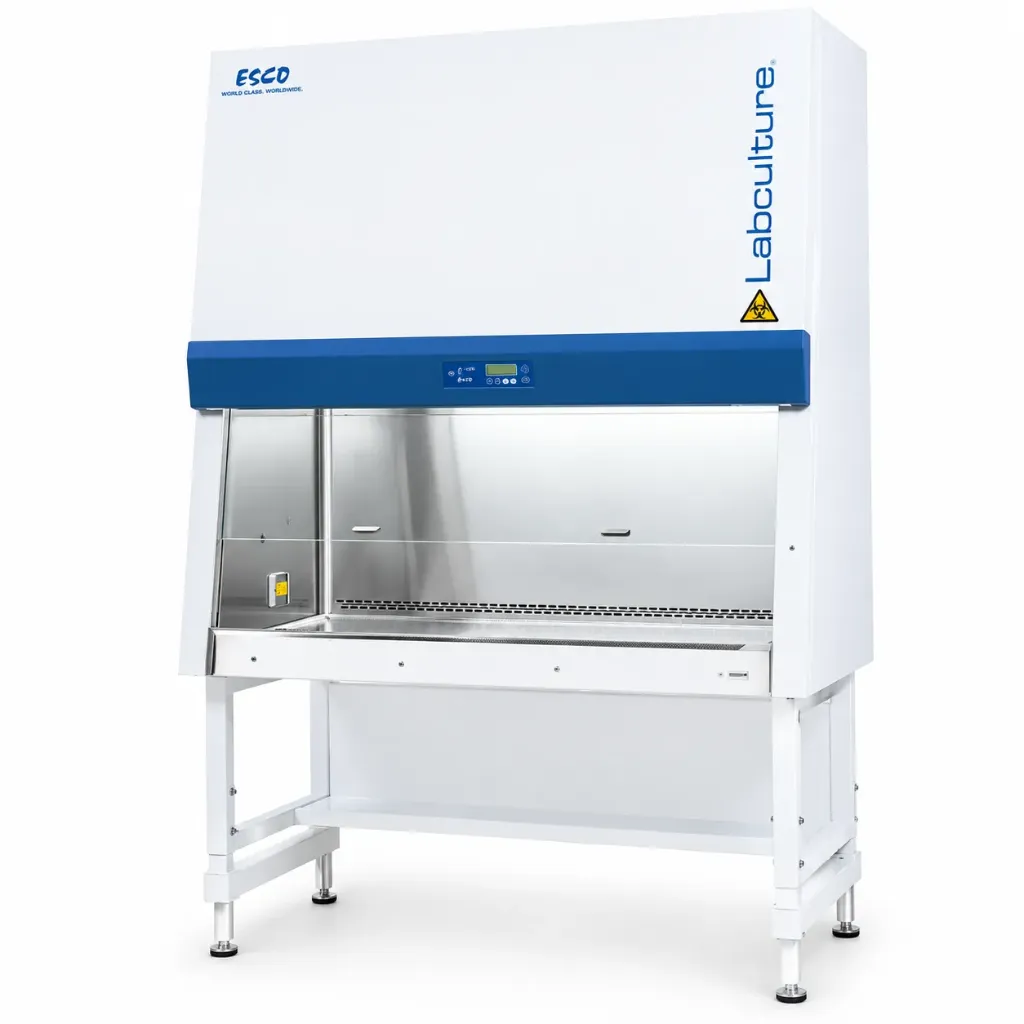
A biological safety cabinet is laboratory containment equipment designed to provide controlled protection for laboratory personnel, samples, and the surrounding environment when working with biological materials. A Class II biological safety cabinet uses controlled airflow and high-efficiency filtration to support safer microbiological and laboratory procedures.
For laboratories, hospitals, research institutions, universities, pharmaceutical facilities, and diagnostic centres, choosing the right biosafety cabinet in Kenya requires consideration of cabinet class, airflow configuration, filtration, working dimensions, installation requirements, and the type of laboratory work being performed.
A biological safety cabinet (BSC) is an enclosed laboratory workstation designed for work involving potentially biohazardous biological materials. Class II models are commonly configured to provide personnel, product, and environmental protection through controlled inward airflow and filtered air circulation.
Kenyan laboratory equipment suppliers currently offer Class II A2 and B2 configurations, with specifications varying by manufacturer and model.
Unlike a standard laboratory bench or chemical fume hood, a biological safety cabinet is specifically designed for biological containment. The appropriate cabinet should therefore be selected according to the organisms, procedures, risk level, and laboratory containment requirements.
A biosafety cabinet in Kenya can be used in a range of laboratory environments where controlled containment is required. Available models include Class II A2 and Class II B2 cabinets, as well as other configurations for specialized laboratory applications.
When purchasing a biosafety cabinet, consider:
Cabinet classification and airflow configuration
HEPA or ULPA filtration system
Working chamber dimensions
Front window configuration
Airflow monitoring and alarms
Electrical requirements
Exhaust requirements
Installation location
Availability of replacement filters and technical support
Manufacturer testing and certification documentation
The exact requirements should be confirmed against the laboratory's intended application before ordering.
A Class II biological safety cabinet is one of the most commonly specified BSC configurations for microbiological and laboratory applications.
Class II cabinets use vertical airflow within the work area together with inward airflow at the front opening. Depending on the specific configuration, air may be recirculated through filtration or exhausted through a dedicated exhaust arrangement.
Class II A2 models are available in several working widths and are commonly configured with filtered recirculated airflow and a portion of filtered exhaust. Current Kenyan supplier listings include Class II A2 models with stainless-steel work areas, airflow monitoring, alarms, motorized front windows, and high-efficiency filtration.
A current Kenyan listing for a Class II A2 cabinet specifies approximately 70% air recirculation and 30% exhaust, although the exact airflow configuration depends on the particular model.
Class II B2 cabinets are designed as total-exhaust configurations. They require appropriate exhaust arrangements and should be installed according to the manufacturer's requirements and the laboratory's ventilation design.
Kenyan suppliers list Class II B2 cabinets with 100% exhaust configurations for specialized laboratory applications.
Because Class II A2 and B2 cabinets have different airflow and exhaust requirements, the cabinet type should be selected based on the laboratory procedure and installation environment rather than price alone.
A laboratory biological safety cabinet can support controlled laboratory work involving biological specimens and other potentially hazardous biological materials.
Typical applications may include:
Microbiology laboratories
Clinical laboratories
Research laboratories
Pharmaceutical laboratories
Diagnostic laboratories
Biotechnology facilities
University and teaching laboratories
Cell culture applications
Sample preparation involving biological materials
The required cabinet classification depends on the work being performed and the applicable laboratory biosafety procedures.
Depending on the selected model, a biological safety cabinet may include:
High-efficiency HEPA or ULPA filtration
Stainless-steel internal work surface
Controlled airflow system
Motorized or manually operated front window
Airflow monitoring
Filter-life monitoring
Visual and audible alarms
LED work lighting
UV lamp on models where specified
Microprocessor control system
Electrical sockets
Adjustable fan speed
Remote control
Optional stand and accessories
For example, current Kenyan listings include Class II A2 cabinets with stainless-steel work areas, motorized front windows, airflow alarms, filter-life indicators, and two high-efficiency filters.
Specifications vary significantly between models. A representative Class II A2 cabinet listed for the Kenyan market may have specifications such as:
These are example configurations rather than specifications for every biological safety cabinet. Exact dimensions, filtration, airflow velocity, electrical requirements, and accessories should be confirmed for the selected model.
The biological safety cabinet price in Kenya depends on the cabinet class, size, filtration system, manufacturer, certification, airflow configuration, accessories, installation requirements, and after-sales support.
As a current Kenya market example, one supplier lists several Class II A2 and B2 biosafety cabinets at KSh 2,000,000 including VAT. This is a supplier listing example and should not be treated as a universal market price because specifications and configurations differ.
Other Kenyan suppliers provide biological safety cabinets on a quotation basis, particularly for different cabinet sizes, brands, and specialized configurations.
For an accurate quotation, confirm:
Required cabinet class
Required working width
A2 or B2 configuration
Filtration requirements
Exhaust arrangement
Accessories required
Delivery and installation requirements
Certification and testing documentation
Warranty and maintenance support
Before purchasing a biosafety cabinet, evaluate the following:
Choose the cabinet classification according to the biological materials and procedures being performed.
Class II A2 and Class II B2 cabinets have different airflow and exhaust arrangements. B2 cabinets, in particular, require appropriate total-exhaust installation.
Choose a cabinet wide enough for the laboratory procedures without overcrowding the work surface.
Confirm the filter type, efficiency, availability, replacement requirements, and manufacturer's documentation.
The cabinet should have adequate space, suitable electrical supply, and any required exhaust connection. Installation should follow the manufacturer's instructions.
For laboratory equipment of this type, access to qualified installation, testing, maintenance, replacement filters, and technical support is an important purchasing consideration.
A biological safety cabinet may be used where controlled containment is required for appropriate laboratory procedures, including microbiological research, diagnostic work, cell culture, and handling of biological specimens.
The specific cabinet and containment measures should be determined by the laboratory's biosafety risk assessment and applicable procedures.
A biological safety cabinet is specialized containment equipment and should be installed, tested, maintained, and used by appropriately trained laboratory personnel.
Important considerations include:
Follow the manufacturer's installation instructions.
Do not block cabinet airflow openings.
Maintain the required front-window position during operation.
Keep the work area appropriately organized.
Perform required maintenance and filter replacement according to the manufacturer.
Arrange appropriate cabinet testing and certification.
Use suitable personal protective equipment and laboratory procedures.
Do not assume a biological safety cabinet provides protection against chemical hazards unless the specific cabinet and application are designed for them.
Class II B2 cabinets require appropriate exhaust infrastructure.
A biological safety cabinet should be selected as part of the laboratory's overall biosafety controls rather than treated as a substitute for proper laboratory procedures.
If you are looking to buy a biological safety cabinet in Kenya, select a supplier that can provide the appropriate cabinet configuration, technical documentation, installation support, maintenance, and replacement filter support.
Models available in Kenya include Class II A2 and Class II B2 configurations from different manufacturers and suppliers.
Request the exact model specification and quotation before purchase so that the cabinet can be matched to your laboratory's intended application and installation requirements.
A biological safety cabinet is an enclosed laboratory workstation that uses controlled airflow and high-efficiency filtration to provide containment and protection during appropriate work involving biological materials.
A Class II biological safety cabinet is a BSC configuration designed to provide controlled airflow and filtration for personnel, product, and environmental protection. Class II A2 and B2 models have different airflow and exhaust arrangements.
The biological safety cabinet price in Kenya varies by model, class, size, filtration, manufacturer, installation, and configuration. One current Kenyan supplier lists Class II A2 and B2 cabinets at KSh 2,000,000 including VAT, while other suppliers provide quotations based on the selected model.
Class II A2 cabinets typically use a combination of filtered recirculation and filtered exhaust, while Class II B2 cabinets are total-exhaust systems. The B2 configuration therefore has more demanding exhaust and installation requirements.
Not automatically. Biological safety cabinets are primarily designed for biological containment. Chemical applications require confirmation that the specific cabinet and exhaust configuration are appropriate for the chemicals involved.
Depending on the cabinet configuration and laboratory requirements, BSCs may be used in clinical, microbiology, research, pharmaceutical, diagnostic, biotechnology, and teaching laboratories.
Product Name: Biological Safety Cabinet
Product Category: Laboratory Equipment
Cabinet Type: Class II Biological Safety Cabinet
Common Configurations: Class II A2 / Class II B2
Primary Application: Laboratory biological containment
Filtration: HEPA or ULPA, model dependent
Installation: Professional installation recommended
Availability: Kenya
These other products might interest you
Allow the use of cookies from this website on this browser?
We use cookies to provide improved experience on this website. You can learn more about our cookies and how we use them in our Cookie Policy.