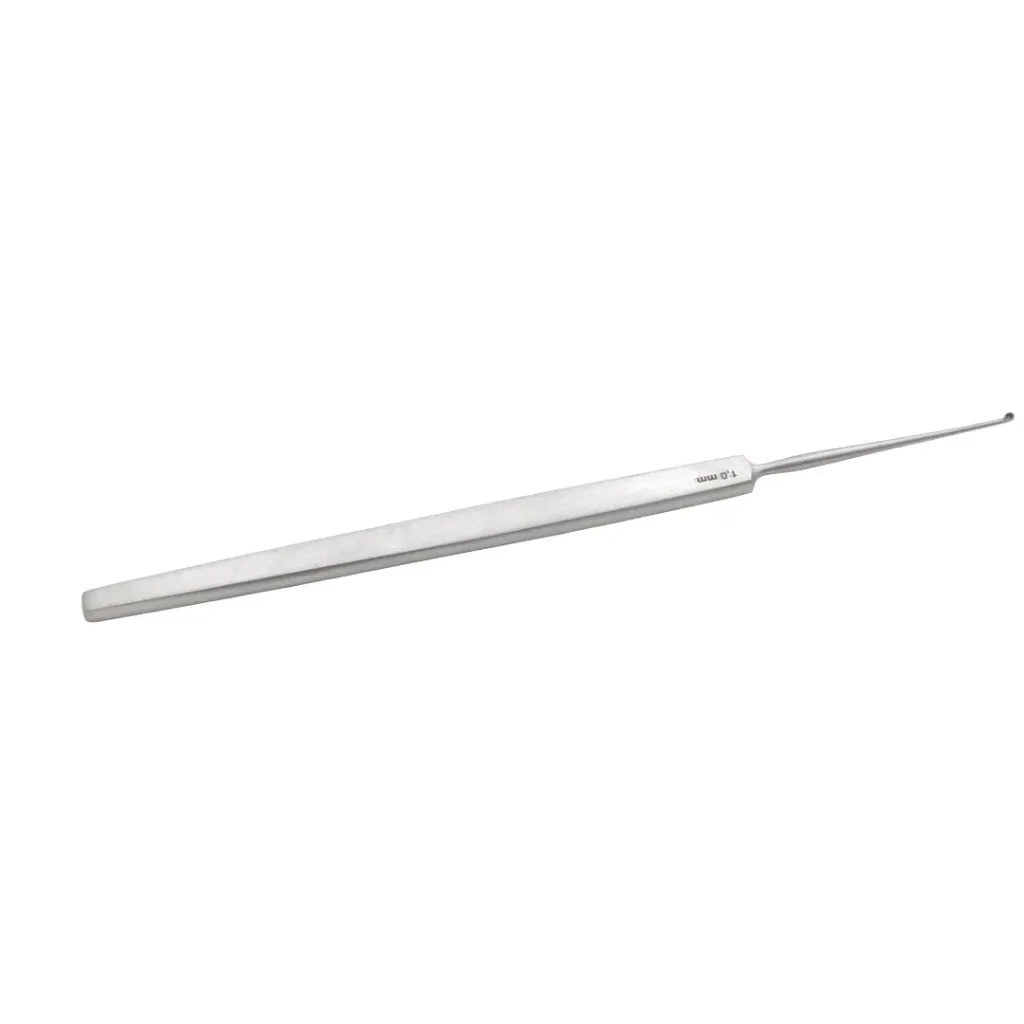
A Probe Dissector is a specialized surgical instrument used by trained healthcare professionals to explore selected anatomical spaces, identify tissue planes, and assist with controlled blunt dissection during appropriate surgical procedures.
Also known as a surgical probe dissector, blunt dissector, blunt surgical probe, surgical dissecting probe, or stainless steel dissecting instrument, the device is commonly used in general surgery, surgical training, specialist procedures, and medical instrument sets.
A conventional probe dissector features a slender metal shaft, a smooth working tip, and a manually controlled handle or gripping section. Depending on the manufacturer, the working tip may be rounded, flattened, curved, angled, or slightly bulbous.
The instrument is generally designed to assist with tissue exploration or separation rather than perform the cutting function of a scalpel.
Important product distinction: Probe Dissector is a broad product description rather than one universally standardized instrument pattern. Some products are simple rounded surgical probes, while others are specifically designed as blunt tissue dissectors with flattened or spatula-shaped working tips.
The correct instrument must therefore be identified by its manufacturer, shape, length, tip dimensions, and intended clinical application.
Smooth, blunt working tip for selected tissue exploration.
Slender shaft for accessing appropriate surgical spaces.
Straight, curved, or angled configurations, depending on the model.
Single-ended or double-ended working designs.
Surgical stainless steel construction in common reusable models.
Manual operation without electricity or batteries.
Different tip widths and overall lengths.
Reusable construction when approved by the manufacturer.
Compatibility with manufacturer-validated cleaning and sterilization.
The probe dissector price in Kenya depends on the instrument pattern, working-tip design, size, material, manufacturer, and whether the product is designed for clinical surgery or educational dissection.
A reliable, publicly advertised Kenyan price for the exact individual surgical Probe Dissector model could not be established.
However, Kenyan medical suppliers advertise related surgical dissection instruments and sets.
International suppliers also list specialized probes, blunt dissectors, and Penfield instruments at different price levels depending on their design and manufacturing requirements.
For an accurate quotation, confirm the exact instrument pattern, dimensions, and clinical-use designation before comparing prices.
Instrument Pattern: A straight blunt probe, double-ended dissector, and Penfield-style instrument can have substantially different constructions.
Working-Tip Design: Rounded, angled, spatulated, and flattened tips have different functions.
Instrument Length: Different working lengths are available for various surgical applications.
Tip Width: Fine working tips require appropriate manufacturing tolerances.
Stainless Steel Quality: Material specifications, corrosion resistance, and surface finishing affect instrument construction.
Single-Ended or Double-Ended Design: Instruments with two working ends may have different manufacturing requirements.
Reusable Status: Reusable instruments require manufacturer-approved cleaning and sterilization instructions.
Clinical or Educational Grade: Instruments intended for anatomy teaching are not automatically approved for use on patients.
Manufacturer Documentation: Product traceability, intended-use labeling, and conformity documents are important procurement considerations.
Institutional Orders: Hospitals purchasing several instrument sizes or surgical sets may request quantity-based quotations.
Buy a Probe Dissector in Kenya from Maesio Pharmaceuticals Limited for hospitals, surgical departments, specialist clinics, medical training institutions, and healthcare facilities.
Product: Probe Dissector – Stainless Steel Blunt Surgical Dissecting Instrument
Category: Surgical Instruments / Probes and Dissectors
Material: Surgical stainless steel, subject to the exact manufacturer specification.
Tip Configuration: Rounded, blunt, flat, angled, or model-specific.
Shaft: Slender surgical shaft.
Length: Confirm the required overall length.
Tip Width: Confirm the manufacturer-specified dimensions.
Working Ends: Single-ended or double-ended, depending on model.
Reusability: Confirm the manufacturer's intended-use labeling.
Sterility: Confirm sterile or nonsterile supply.
Application: Appropriate surgical exploration and blunt tissue dissection.
Delivery: Nairobi and countrywide Kenya, with East African deliveries available by arrangement.
Ordering Recommendation: Specify whether you require a blunt surgical probe, a tissue-plane dissector, a grooved director, or a named instrument such as a Penfield dissector.
Browse surgical and medical equipment products at https://www.maesiopharmaceuticals.co.ke/shop.
Healthcare institutions looking to buy probe dissector in Nairobi should consider the clinical application and required instrument geometry.
Some surgical probes are primarily intended for gentle exploration of selected openings, tracts, or anatomical spaces.
Blunt dissectors, by comparison, often have flattened or shaped working ends designed to assist with separating tissue along an existing anatomical plane.
Although the terms overlap in some supplier catalogs, the instruments are not always interchangeable.
Public referral hospitals
Private hospitals
General surgical departments
Specialist operating theaters
ENT departments
Orthopedic surgical departments
Reconstructive surgery centers
Medical teaching institutions
Surgical skills laboratories
Clinical training facilities
The exact product must be appropriate for the intended patient or educational application.
A surgical probe dissector for sale in Kenya may be manufactured in several configurations.
Selected probes feature rounded or bulbous ends intended for gentle exploration of appropriate anatomical structures.
Some dissectors have flattened working surfaces designed to separate suitable tissue planes.
Different designs support access to particular surgical areas.
Certain instruments feature one working tip, while others provide different tips at opposite ends.
Reusable clinical instruments commonly use surgical stainless steel.
The instrument does not require an external power source.
Available lengths depend on the manufacturer and instrument pattern.
Approved models may undergo repeated cleaning, inspection, and sterilization.
Maesio Pharmaceuticals Limited supplies surgical instruments, operating theater equipment, medical consumables, diagnostic devices, and hospital supplies to healthcare facilities across Kenya and East Africa.
Hospitals looking for a blunt dissector instrument supplier in Kenya should provide the exact instrument pattern, intended use, working-tip dimensions, and manufacturer requirements.
Explore surgical instruments and related equipment through www.maesiopharmaceuticals.co.ke.
Exact probe or dissector instrument pattern.
Intended surgical specialty.
Clinical-use or educational-use designation.
Blunt, rounded, flattened, or angled tip.
Overall instrument length.
Working-tip width.
Straight or curved configuration.
Single-ended or double-ended construction.
Stainless steel material specification.
Surface finish.
Manufacturer and reference number.
Reusable or single-use labeling.
Sterility on supply.
Validated reprocessing instructions.
Quantity and packaging.
Stock and delivery requirements.
A stainless steel probe dissector in Kenya is commonly selected for surgical instrument inventories where a reusable manual instrument is required.
Mechanical Strength: Appropriate surgical-grade stainless steel provides structural support for the instrument's intended use.
Smooth Surface Finish: Proper finishing helps reduce unnecessary tissue snagging and facilitates inspection.
Corrosion Resistance: Suitable stainless steel grades can resist corrosion when correctly maintained.
Reusable Design: Manufacturer-approved versions can undergo validated processing between clinical uses.
Long-Term Instrument Inventory: Healthcare facilities can maintain and replace instruments according to their approved equipment schedules.
The exact stainless steel grade must be confirmed with the manufacturer. The term stainless steel alone does not establish surgical suitability.
A surgical dissecting probe in Kenya may be used in selected procedures where tissue exploration, identification, or blunt separation is clinically appropriate.
Appropriately designed blunt dissectors may be used to assist a surgeon in separating selected tissue layers along an existing anatomical plane.
Suitable rounded surgical probes may help clinicians examine selected accessible spaces or structures under appropriate surgical conditions.
Some dissectors are designed to assist with identifying or maintaining separation between tissue planes.
Blunt dissecting instruments may be included in surgical trays for procedures requiring careful tissue manipulation.
Specialized dissector patterns, including Freer and Cottle instruments, are used in selected nasal and reconstructive surgical procedures.
Particular blunt dissectors, such as some Penfield patterns, are designed for specialist surgical applications.
Educational dissecting probes are commonly included in anatomy and surgical training sets.
Clinical limitation: A probe dissector is not a universal exploration instrument. Blind probing, excessive force, or use in inappropriate tissue planes can create false passages, cause bleeding, damage nerves or vessels, or injure surrounding structures.
A straight surgical probe generally has a slender shaft and a rounded working end.
It may be used for selected examination or exploration tasks according to the manufacturer's approved purpose.
A curved instrument provides a different working approach for appropriate anatomical access.
A double-ended dissector incorporates two working tips, which may differ in width, curvature, or shape.
A flattened working end can be designed to help separate selected tissue layers.
Penfield dissectors are specialized instruments available in several configurations, including blunt, curved, cupped, and double-ended patterns.
Freer instruments are commonly used in selected ENT and nasal procedures involving tissue elevation.
A grooved director has a channel along part of its shaft and is a distinct instrument pattern.
Some surgical probes are manufactured with an intentionally bendable shaft, allowing controlled shaping where permitted by the manufacturer.
A malleable probe should not be confused with a rigid blunt dissector.
There is no single universal length or tip width for all probe dissectors.
Manufacturer catalogs list various examples:
These are examples of distinct instrument types, not confirmed sizes or models offered by Maesio.
The working-tip width determines part of the instrument's contact profile.
A narrow tip may provide access to smaller areas, while a broader tip may be designed for different tissue-plane manipulation.
The surgeon should select the appropriate tip geometry and size for the intended procedure.
A blunt tip is not automatically atraumatic, and no instrument should be used beyond its intended purpose.
The instrument's intended use and working-end geometry should guide procurement.
A Penfield dissector should only be supplied when the requested design matches the clinical specification.
A grooved director is not the same as a standard blunt dissector.
The presence or absence of the groove must be confirmed before ordering.
These instruments may be included in the same surgical set but serve different functions.
A scalpel is designed to cut tissue using a sharp blade.
A blunt probe dissector is generally designed for selected exploration or tissue separation without the same cutting action.
However, some dissector patterns include sharpened surfaces or combined sharp and blunt working ends. The instrument must therefore be selected and handled according to its exact design.
The tip should match the specified blunt or dissector profile without unwanted burrs or manufacturing defects.
The shaft should have the rigidity or malleability specified for the instrument.
The width, angle, and length should match the hospital's approved instrument requirements.
The instrument should provide suitable grip and working reach.
Reusable clinical models should be manufactured from an appropriate material with supporting documentation.
Smooth finishing helps facilitate cleaning and reduces avoidable snagging.
Manufacturer-approved models should be capable of undergoing validated reprocessing.
Specialized Tissue Handling: Appropriate models support controlled exploration and separation during selected procedures.
Multiple Instrument Designs: Straight, curved, flattened, and double-ended patterns are available.
Manual Operation: No electricity or battery is required.
Reusable Availability: Stainless steel clinical models can provide repeated service with validated maintenance.
Surgical Tray Integration: Probe dissectors may form part of general or specialty surgical instrument sets.
Clinical Training: Educational models can support supervised teaching, provided they are not mistakenly used as patient-contact surgical devices.
Before buying, confirm:
Instrument name: Probe dissector or a specific named pattern.
Clinical application: General surgery, ENT, orthopedic, neurosurgery, or educational use.
Tip design: Rounded, bulbous, flattened, angled, or curved.
Working ends: Single or double.
Overall length: Specify in centimeters or millimeters.
Tip width: Confirm exact dimensions.
Shaft profile: Straight, curved, rigid, or malleable.
Material: Request surgical stainless steel specifications.
Surface finish: Check for smooth edges and absence of defects.
Handle: Confirm suitable gripping design.
Patient-use approval: Verify the device is intended for clinical use.
Reusability: Check manufacturer labeling.
Sterility: Confirm supply condition.
Cleaning: Obtain validated reprocessing instructions.
Manufacturer: Confirm brand and reference number.
Packaging: Individual instrument or set.
Delivery: Verify stock and shipping arrangements.
Reusable clinical probe dissectors must undergo appropriate reprocessing between patient uses.
Follow the manufacturer's validated instructions, paying attention to the working tip, shaft, handle, surface grooves, and any joints.
Check for:
Bent or damaged working tips
Unintended sharp edges
Corrosion or pitting
Cracks or deformation
Damaged handles
Excessive bending of rigid models
Surface defects
Residual contamination
Many reusable stainless steel surgical probes and dissectors are compatible with steam sterilization.
However, the approved sterilization cycle, packaging, and drying requirements must follow the exact manufacturer's instructions.
Keep processed instruments in designated instrument trays or packaging that protects the working tips and maintains the appropriate clinical condition.
Remove an instrument from use if its shape, surface integrity, structural strength, or reprocessing suitability is compromised.
A reliable public retail price for the exact individual clinical-grade Probe Dissector was not verified. Prices depend on instrument design, dimensions, manufacturer, and material.
You can inquire through Maesio Pharmaceuticals Limited for probe dissectors and related surgical instruments.
It is a surgical instrument used for selected tissue exploration and blunt separation during appropriate procedures.
It may be used to assist with separating appropriate tissue layers without the cutting action of a scalpel.
Probe and dissector instruments can be sourced through surgical equipment suppliers. Exact model availability should be confirmed.
Many reusable clinical models are manufactured from surgical stainless steel.
No. Some specialized dissectors have sharp or partially sharpened working surfaces.
A probe is generally associated with exploration, while a dissector is designed to help separate tissues. Some instruments combine both functions.
Sizes depend on the design. Some surgical probes are available in lengths from approximately 14 to 25 cm.
Yes. Selected manufacturers list probes with these tip widths.
Yes. Curved configurations are available.
Yes. Several manufacturers produce double-ended instruments with different working tips.
It is a named family of surgical dissectors offered in different numbered configurations.
Not necessarily. Penfield refers to a specific instrument family.
It is a surgical probe-like instrument with a longitudinal groove used for specific guidance functions.
No. Dissecting forceps have grasping jaws, while a probe dissector usually has a solid working tip.
Selected models are intended for appropriate general surgical procedures.
Specialized dissector patterns are used in selected ENT procedures.
Certain specialist dissectors, including selected Penfield patterns, are associated with neurosurgical applications.
No. A blunt dissector and scalpel have different functions.
Many clinical stainless steel models are reusable according to their manufacturer labeling.
Many reusable stainless steel models are steam-sterilizable under manufacturer-approved conditions.
Not necessarily. Many reusable surgical instruments are supplied nonsterile.
Follow the exact manufacturer's validated cleaning instructions.
Yes. Incorrect use or excessive force can damage tissue.
Yes. Educational dissecting probes are included in selected anatomy and dissection sets.
Not automatically. Educational instruments are not necessarily approved for patient-contact clinical use.
A Freer elevator is a specialized instrument for selected tissue-elevation procedures, while blunt dissector is a broader category.
Request the manufacturer-specified surgical instrument material and relevant product documentation.
Yes. Healthcare facilities can request quotations for specified instruments and quantities.
Check the working-tip finish, shaft alignment, material specification, dimensions, manufacturer labeling, and absence of defects.
Only if the manufacturer permits reshaping or authorized repair. Rigid instruments should not be bent or repaired arbitrarily.
No. Clinical probe dissectors are intended for trained healthcare professionals.
Maesio Pharmaceuticals supplies medical equipment across Kenya and can arrange delivery to East African destinations, subject to order requirements.
Confirm the instrument pattern, intended use, tip geometry, length, steel specification, reusable status, manufacturer, packaging, and availability.
Specification note: The Probe Dissector is a broad surgical instrument category. Exact working-tip geometry, length, steel grade, and intended use must be confirmed for the particular Maesio product before publication.
These other products might interest you
Allow the use of cookies from this website on this browser?
We use cookies to provide improved experience on this website. You can learn more about our cookies and how we use them in our Cookie Policy.