
MAESIO JOURNAL · SICKLE CELL CARE IN KENYA
Closer care. More hope for families.
What JOOTRH’s automated red cell exchange service means—and the questions families should ask before planning treatment.
Some of the hardest parts of sickle cell disease never appear in a medical file: the night a parent stays awake, the school day a child misses, the journey that costs another day’s wages. Better access to specialist care can ease part of that burden. It deserves hope grounded in clear information.
Know when to seek urgent care
For someone with sickle cell disease, a temperature of 38.5°C or higher needs urgent hospital assessment. Follow any lower threshold in your own care plan. Chest pain, breathing difficulty, sudden weakness, speech changes, seizures or severe deterioration also require immediate medical help. Do not wait for an exchange appointment or a WhatsApp reply.
What JOOTRH has confirmed
In a report dated 28 January 2026, Jaramogi Oginga Odinga Teaching and Referral Hospital announced the commissioning of a Spectra Optia apheresis machine at its Victoria Annex. The hospital described permanent installation as an improvement on an earlier arrangement that depended on bringing equipment in when needed.
JOOTRH’s current Victoria Annex page lists sickle cell disease management, haematology and automated red blood cell exchange among its services. The facility is in Milimani, Kisumu. These are hospital-reported details, not a guarantee of a same-day appointment or uninterrupted availability.
Check JOOTRH’s Victoria Annex service information →
What the machine actually does
Automated red cell exchange removes some red blood cells containing sickle haemoglobin and replaces them with compatible donor red cells. Other blood components are returned through a monitored procedure.
| Simple transfusion | Automated exchange |
|---|---|
| Adds donor red cells without routinely removing the patient’s red cells. | Removes some of the patient’s red cells while replacing them with donor red cells. |
The aim is to lower the proportion of sickle haemoglobin and manage a specific clinical risk. The procedure does not change the inherited cause of sickle cell disease, and it is not a cure.
Who might benefit?
A specialist may consider exchange for selected serious complications or a planned prevention programme. Examples include stroke-related care, severe acute chest syndrome and some other situations in which transfusion is indicated. A diagnosis of sickle cell disease does not automatically mean that exchange is needed.
The haematology team weighs the person’s history, blood results, previous transfusions and antibodies, available vein access and treatment goals. A parent should leave the consultation understanding why this procedure is being proposed for this patient.
How long does it take—and how often?
UCLH’s patient guidance gives roughly two hours for the exchange itself, with extra time for preparation and monitoring. That is a general example, not JOOTRH’s appointment timetable. Ask the local team how much time to allow.
Some people need a single exchange; others need repeated treatment. The schedule is individual. Do not assume that “a few times a year” or “every month” is right for every child or adult.
Benefits come with risks to discuss
Automated exchange can reduce sickle haemoglobin and may limit iron accumulation compared with some repeated simple-transfusion programmes. It still requires specialist monitoring and suitable donor blood.
Possible problems include transfusion reactions, antibody formation, low calcium symptoms, changes in blood pressure and complications related to the access line. Tell the team immediately if symptoms develop during treatment, and ask for written instructions about problems to report afterwards.
The questions families should ask
| Before the visit | What to confirm |
|---|---|
| Clinical assessment | Is a referral required? Which clinic assesses suitability, and what records are needed? |
| Preparation | When are blood tests needed? How is suitable donor blood arranged? |
| The visit | How long should we allow, and can a caregiver attend? |
| Costs and cover | What is the written estimate? What is covered, what needs authorisation and what remains payable? |
| Aftercare | Who do we contact with a problem, and when is the next review? |
Do not make travel plans based on an online article alone. Confirm service availability and the full plan directly with JOOTRH. Coverage, eligibility and charges can change; this article does not promise free treatment or a particular reimbursement amount.
Why this matters beyond one machine
More reliable local access may reduce some of the travel and uncertainty families face. But equipment works within a system: trained teams, compatible blood, testing, maintenance, referral pathways and follow-up all matter.
For a parent, meaningful progress may be a clearer plan and fewer unanswered questions. It should not be presented as a promise that every crisis will disappear.
Exchange is part of a wider care plan
Ongoing sickle cell care includes individual pain plans, infection prevention, recommended vaccinations, screening and specialist follow-up. Hydroxyurea can reduce complications for appropriate patients, but it needs prescribing and monitoring. Do not stop prescribed treatment because an exchange service is available.
Avoid starting iron supplements simply because someone has anaemia: repeated transfusions can cause iron overload. Ask the treating team what is appropriate for the individual.
Frequently asked questions
Does red cell exchange cure sickle cell disease?
No. It changes the circulating red-cell mixture for a period of time; it does not remove the underlying inherited condition.
Is it only for children?
No. Specialist assessment can include children and adults. Eligibility depends on clinical need and the service’s arrangements.
Can we arrive and request the procedure?
Contact the hospital first. Assessment, blood preparation and scheduling are needed.
Can a home thermometer tell whether a crisis is serious?
No. Temperature is one piece of information. A normal reading does not rule out a serious complication.
A practical home-care essential
A thermometer can help a family measure and report temperature as part of the clinician’s care plan. It cannot diagnose a sickle cell crisis, replace hospital assessment or make waiting safe when someone is unwell.
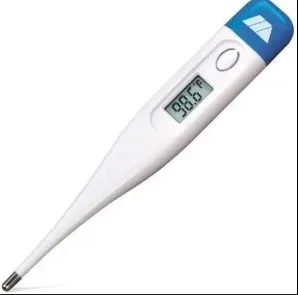 | Digital ThermometerExplore Maesio’s listing for routine temperature measurement. Confirm suitability for the patient’s age and follow the product instructions. |
Need help finding a routine care product?
Maesio can assist with product information and availability. Hospital appointments, exchange eligibility and treatment costs must be discussed with JOOTRH.
Ask about care products on WhatsApp ↗
Written by Justina Mwongeli. Updated with service-source checks and practical patient questions.
Sources and further reading
- JOOTRH: machine commissioning report, 28 January 2026
- JOOTRH: Victoria Annex facility and contact information
- UCLH: automated red cell exchange patient guide
- CDC: prevention and treatment of sickle cell complications
- CDC: fever in sickle cell disease
- NHLBI: sickle cell treatment
Updated 28 October 2026. General education, not personal medical advice. Maesio is not JOOTRH’s booking service. The cover is an illustrative scene, not a photograph of the hospital, its equipment or an identified patient.