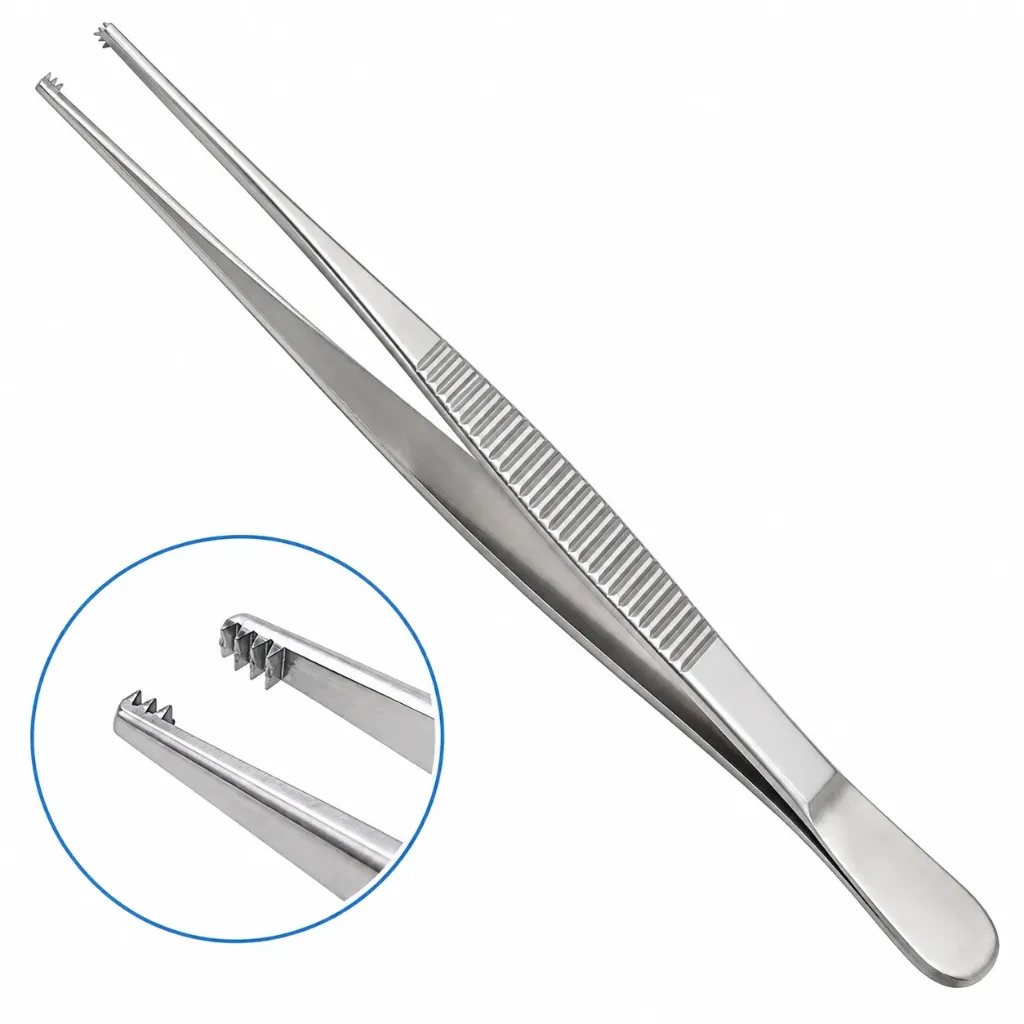
Waugh/Gillies Toothed Dissecting Forceps are precision surgical instruments designed for grasping, holding, and manipulating tissue during selected surgical and dissection procedures. Also known as Waugh tissue forceps, Gillies dissecting forceps, 1×2 toothed dissecting forceps, or surgical tissue-grasping forceps, these instruments are commonly used in general surgery, ear, nose, and throat (ENT) procedures, plastic and reconstructive surgery, and other specialties requiring controlled tissue handling.
These instruments belong to the thumb-forceps family. Unlike artery forceps, which usually have finger rings and locking ratchets, conventional Waugh and Gillies dissecting forceps operate through a spring-action handle. The clinician applies finger pressure to bring the jaws together and releases pressure to open them.
A key characteristic of toothed Waugh and Gillies forceps is the 1×2 toothed tip, which features one tooth engaging between two opposing teeth. This configuration helps provide a controlled grip on appropriate tissues. Selected patterns also feature cross-serrated gripping surfaces to improve purchase during dissection.
Although the names are sometimes grouped in medical equipment catalogs, Waugh and Gillies are distinct instrument patterns.
Waugh forceps are commonly associated with ENT procedures and are available in longer configurations. Gillies forceps are typically finer, with narrow jaws suitable for delicate tissue manipulation in plastic, reconstructive, and selected general surgical procedures.
International manufacturers identify typical specifications such as:
Waugh forceps: Straight jaws, 1×2 teeth, cross-serrated tips, and lengths including 18 cm and 20 cm.
Gillies forceps: Fine straight jaws, 1×2 teeth, cross-serrated gripping surfaces, and a commonly marketed length of 15.5 cm.
The exact instrument supplied under a combined Waugh/Gillies product name must be confirmed before ordering.
The Waugh dissecting forceps price in Kenya depends on the exact instrument pattern, length, stainless steel grade, jaw design, manufacturing quality, surface finish, and supplier.
The exact Waugh/Gillies-pattern forceps do not have a consistently verifiable public retail price in the Kenyan listings checked. However, comparable toothed dissecting forceps are advertised by the following suppliers.
Kenyan Supplier
Comparable Product
Advertised Price
The Farlays Healthcare
Generic toothed or non-toothed dissecting forceps
KSh 300
Kijani Medical Limited
Dissecting forceps, toothed or non-toothed
KSh 320
Jumia Kenya
Generic dissecting forceps
KSh 999
Dissecting forceps with toothed variant
KSh 1,500
The advertised prices provide context for the broader Kenyan dissecting forceps market. Genuine Waugh or Gillies models should be quoted according to their exact configuration and manufacturer.
Buy Waugh/Gillies Toothed Dissecting Forceps in Kenya from Maesio Pharmaceuticals Limited for hospitals, surgical theaters, ENT departments, plastic surgery centers, medical clinics, and healthcare institutions.
Product: Waugh/Gillies Toothed Dissecting Forceps – Stainless Steel Tissue-Grasping Instrument
Supplier: Maesio Pharmaceuticals Limited
Instrument Type: Spring-action toothed dissecting forceps.
Jaw Design: Confirm Waugh or Gillies pattern, 1×2 teeth, and serration configuration.
Material: Surgical stainless steel, subject to the selected model's specifications.
Length: Confirm the exact size before ordering.
Intended Use: Professional tissue grasping and dissection during approved surgical procedures.
Reusability: Confirm manufacturer labeling.
Sterilization: Follow validated manufacturer instructions for reusable instruments.
Delivery: Nairobi and countrywide Kenya, with East African shipping available by arrangement.
Ordering Advice: Confirm whether the requested instrument is specifically Waugh or Gillies, as these are related but different patterns.
An exact Maesio product page for this combined listing could not be verified, so an unconfirmed product URL has not been inserted.
Healthcare institutions looking to buy Gillies toothed forceps in Nairobi should prioritize precise jaw construction, appropriate instrument length, and reliable stainless steel finishing.
Gillies dissecting forceps are known for their fine, narrow tips, which are suitable for selected delicate tissue-grasping tasks.
The toothed working end can help hold tissue securely, while the spring-action handle allows the operator to regulate the applied grip.
General surgery departments
Plastic and reconstructive surgery
ENT surgical departments
Selected oral and maxillofacial procedures
Gynecological surgical procedures
Orthopedic surgery
Neurosurgical instrument sets, where specified
Specialist outpatient surgery centers
Surgical training institutions
The correct instrument must be selected according to the surgical procedure and clinician's preference.
Toothed dissecting forceps for sale in Kenya include several different surgical patterns.
A proper Waugh or Gillies instrument should not be confused with ordinary toothed thumb forceps.
A single tooth on one jaw meets two opposing teeth on the other jaw to provide a mechanical grip.
Selected Waugh and Gillies patterns include serrations that support controlled tissue handling.
Gillies forceps are especially associated with fine, narrow jaws.
The instrument opens when thumb pressure is released.
Textured gripping areas help prevent unwanted slipping during handling.
Many reusable instruments are manufactured from surgical stainless steel.
Some models use a matte or satin finish to reduce reflected glare.
Manufacturer catalogs identify Gillies forceps around 15.5 cm and Waugh forceps in longer lengths.
Choosing a reliable Waugh Gillies forceps supplier in Kenya helps healthcare facilities obtain instruments that match their approved surgical tray specifications.
Maesio Pharmaceuticals Limited supplies surgical instruments, operating theater equipment, hospital consumables, diagnostic products, and medical equipment to healthcare facilities across Kenya and East Africa.
The Waugh/Gillies Toothed Dissecting Forceps product category is relevant to hospitals and specialist surgical departments purchasing tissue-handling instruments.
Explore surgical equipment, medical consumables, and related products through www.maesiopharmaceuticals.co.ke.
Exact Waugh or Gillies pattern
Straight or other manufacturer-specified jaw configuration
1×2 toothed working tips
Cross-serration design
Instrument length
Jaw profile and dimensions
Surgical stainless steel specification
Spring handle operation
Surface finish
Sterile or nonsterile supply
Reusable or disposable labeling
Validated reprocessing instructions
Manufacturer identification
Unit quantity
Stock availability and delivery arrangements
Surgical tissue-grasping forceps are instruments designed to hold, stabilize, or manipulate tissues during selected operations.
The gripping mechanism influences the type of tissue for which a particular forceps pattern is appropriate.
Toothed forceps provide mechanical engagement with tissue but can also cause injury if excessive pressure is applied or if the teeth are used on unsuitable structures.
General surgery: Holding appropriate tissue edges during exposure, dissection, and suturing.
ENT surgery: Waugh forceps may be used for selected ear and tonsillar procedures, depending on instrument length and design.
Plastic and reconstructive surgery: Gillies forceps are commonly used for precise grasping of suitable skin and soft tissues.
Gynecological surgery: Selected dissecting forceps may form part of specialized surgical instrument trays.
Oral and maxillofacial surgery: Appropriate fine tissue forceps may assist with selected tissue-handling tasks.
Surgical training: Instruments may be used for identification and supervised practical skills.
These instruments must be used by appropriately trained and authorized healthcare professionals. Their toothed jaws can damage delicate tissues if incorrectly applied.
Feature
Waugh Dissecting Forceps
Gillies Dissecting Forceps
Instrument Family
Tissue dissecting forceps
Fine tissue dissecting forceps
Common Clinical Association
ENT surgery
Jaw Profile
Narrow working jaws
Fine, narrow working jaws
Toothed Options
1×2 teeth available
1×2 teeth commonly specified
Serrations
Cross-serrated options
Handle Type
Spring-action thumb handle
Typical Catalog Lengths
18, 20 cm and longer variants
Commonly 15.5 cm
Material
Typically surgical stainless steel
Reusable
Manufacturer dependent
The exact instrument patterns and dimensions should be verified against the manufacturer's technical catalog.
Waugh/Gillies Forceps
Standard Toothed Dissecting Forceps
Jaw Design
Specialized pattern
General-purpose pattern
Tip Teeth
Typically 1×2 in toothed versions
May be 1×2 or another configuration
Cross-Serrations
Common in these patterns
Model dependent
Length
Pattern dependent
Wide range
Surgical Specialty
Often selected for finer or specialist tasks
General tissue handling
Price Comparison
Requires exact-model matching
Broader market availability
A generic toothed forceps should not automatically be substituted for a named Waugh or Gillies pattern on a hospital procurement list.
Gillies Forceps
Adson Toothed Forceps
Design
Narrow, elongated surgical pattern
Typically shorter, broader gripping handle
Teeth
Commonly 1×2
Commonly 1×2 in toothed models
Cross-serrated designs
Typical Applications
Selected fine and deeper dissection
Skin and superficial tissue handling
Overall Length
Often around 15.5 cm
Varies, often shorter
Selection
According to surgical needs
Both can provide a firm tissue grip, but they are different instrument patterns.
Toothed Forceps
Non-Toothed Forceps
Tip
Interlocking teeth
Serrated or smooth gripping surface
Grip
Mechanical tissue engagement
Friction-based grasp
Potential Tissue Injury
Teeth can penetrate or damage tissue
Pressure and friction can still injure tissue
Common Use
Selected skin and suitable connective tissues
Tissue selected according to instrument design
Interchangeability
Requires professional assessment
Neither category is inherently atraumatic. Instrument selection and applied force matter.
Waugh and Gillies forceps are thumb-operated tissue forceps, not conventional locking artery forceps.
Artery Forceps
Handles
Spring-action thumb grips
Usually finger-ring handles
Locking Ratchet
Generally absent
Usually present
Primary Function
Tissue grasping and manipulation
Selected vessel and tissue clamping
Jaw Configuration
Fine toothed/serrated tips
Hemostatic serrations
Operation
Manual pressure
May lock in position
An artery forceps should not be treated as a direct replacement for a fine dissecting forceps.
The specialized tips provide controlled engagement with suitable tissues.
Narrow jaws can facilitate access to selected surgical areas.
Spring handles allow opening and closing without a conventional ratchet.
Textured handles and appropriate instrument balance may support secure handling.
Manufacturer-approved stainless steel models can be reused after validated reprocessing.
Different patterns may be incorporated into ENT, plastic surgery, and general surgical instrument sets.
Hospitals can specify the correct pattern, length, and tooth arrangement in their instrument purchase orders.
Before purchasing, evaluate:
Pattern: Waugh or Gillies.
Length: Confirm the required overall measurement.
Teeth: Verify 1×2 interlocking teeth.
Serrations: Confirm the specified gripping surface.
Jaw alignment: Teeth should meet correctly without distortion.
Tip condition: Check for sharp manufacturing defects or damage.
Spring action: Confirm smooth opening and closing.
Grip: Assess handle texture and instrument balance.
Material: Verify surgical stainless steel.
Finish: Confirm smooth, appropriate surface treatment.
Reusability: Check the manufacturer's stated intended use.
Sterility: Confirm whether the instrument is supplied sterile or requires processing.
Reprocessing: Obtain validated cleaning and sterilization instructions.
Documentation: Request product identification and applicable conformity information.
Quantity: Match the approved surgical tray list.
Delivery: Confirm stock, packaging, and procurement arrangements.
Reusable Waugh/Gillies dissecting forceps require controlled cleaning and reprocessing between clinical uses.
Used instruments should be handled according to healthcare facility procedures. The toothed tips and serrated surfaces require particular attention because contamination can remain in small recesses.
Inspect each forceps for:
Bent or misaligned tips
Damaged 1×2 teeth
Worn serrations
Corrosion or pitting
Cracked or deformed handles
Impaired spring tension
Rough surfaces
Residual contamination
Many reusable surgical stainless steel dissecting forceps are compatible with steam sterilization, but the exact parameters must follow the manufacturer's validated instructions.
Do not assume a universal temperature, exposure period, or reprocessing method for all forceps.
Store cleaned and sterilized instruments according to facility procedures, protecting fine tips against bending and impact.
Remove forceps from service when the tips no longer align, teeth are broken, the spring mechanism fails, significant corrosion develops, or the instrument cannot be adequately reprocessed.
Use only for manufacturer-approved surgical applications.
Select the appropriate jaw profile for the tissue.
Avoid excessive pressure that can crush or tear tissue.
Do not use damaged or poorly aligned forceps.
Follow validated reprocessing before clinical reuse.
Do not use nonsterile instruments in procedures requiring sterile instruments.
Do not substitute a different forceps pattern without clinical approval.
These instruments are intended for trained professionals, not home medical procedures.
Comparable generic toothed dissecting forceps are advertised in Kenya from approximately KSh 300 to KSh 1,500. A verified price for the exact Waugh pattern was not established, so its price should be requested using the precise instrument specification.
You can inquire through Maesio Pharmaceuticals Limited for Gillies-pattern forceps and other professional surgical instruments.
They are specialized spring-action tissue forceps with toothed gripping tips used for selected surgical tissue-handling procedures.
No. They are related but distinct surgical instrument patterns with differences in design, dimensions, and typical clinical applications.
Waugh forceps are commonly associated with selected ENT procedures, including tissue dissection and handling.
Gillies forceps are used for controlled grasping and manipulation of suitable tissues in plastic, reconstructive, and other surgical procedures.
Yes. International manufacturers commonly identify Waugh forceps as ENT tissue-handling instruments.
Yes. They are widely marketed for fine tissue handling in plastic and reconstructive surgery.
It refers to a tip configuration with one tooth on one jaw and two opposing teeth on the other jaw.
Many reusable models are manufactured from surgical stainless steel.
The requested version is toothed. Other related patterns may have different tip configurations.
Toothed forceps use interlocking teeth, while non-toothed versions rely on serrated or smooth gripping surfaces.
Yes. Selected Gillies designs have cross-serrated gripping surfaces and 1×2 tip teeth.
A commonly listed manufacturer length is 15.5 cm, although other variants may exist.
Manufacturer catalogs identify several lengths, including 18 cm and 20 cm, with longer options available.
Yes. Straight Waugh patterns are available.
Conventional dissecting forceps patterns use spring-action thumb handles rather than locking ratchets.
No. Gillies and Adson forceps have different instrument designs and proportions.
Yes, when the selected model is appropriate to the procedure and the tissue.
Selected Gillies or similar dissecting forceps may be used in suitable gynecological procedures according to clinical requirements.
Many surgical stainless steel models are reusable, provided they are labeled and validated for reprocessing.
Many reusable surgical stainless steel forceps are steam-sterilizable according to manufacturer instructions.
Not necessarily. Reusable surgical instruments are frequently supplied nonsterile and require appropriate processing before use.
Follow the manufacturer's validated reprocessing instructions and pay particular attention to the teeth, serrations, and spring handle.
Yes. Incorrect pressure or use on unsuitable tissues can cause injury.
They may be suitable for selected delicate tissues when the correct pattern is used by a trained clinician. Their teeth still require careful handling.
Yes. Some international manufacturers offer Gillies forceps with tungsten carbide working components. Availability depends on the supplier.
Inspect the jaw alignment, tooth engagement, spring action, serrations, surface finish, and manufacturer documentation.
Dissecting forceps usually use spring-action thumb handles for grasping tissue, while conventional artery forceps have ring handles and ratchets for clamping.
Yes. Hospitals and surgical departments can request quotations for specified models and quantities.
They may be included in ENT, plastic surgery, or other specialist sets depending on the approved instrument list.
No. They are professional surgical instruments intended for trained and authorized healthcare personnel.
Maesio Pharmaceuticals supplies medical equipment across Kenya and can arrange delivery to East African destinations.
Confirm the exact pattern, instrument length, 1×2 teeth, serrations, stainless steel specification, reusability, sterilization instructions, and packaging.
Specification
Details
Product Name
Waugh/Gillies Toothed Dissecting Forceps
Alternative Names
Waugh Tissue Forceps, Gillies Dissecting Forceps, Toothed Surgical Tissue Forceps
Product Category
Surgical Instruments / Dissecting Forceps
Product Type
Spring-action surgical tissue-grasping instrument
Available Patterns
Waugh and Gillies; confirm exact model
Main Function
Grasping and manipulating selected surgical tissues
Working Tip
Toothed
Common Tooth Configuration
1×2 teeth
Cross-serrated configurations available
Jaw Shape
Straight in commonly listed models
Narrow; exact design model dependent
Finger-Ring Handles
Not standard
Ratchet Lock
Typical Gillies Length
15.5 cm, manufacturer dependent
Example Waugh Lengths
18 cm and 20 cm; additional variants available
Exact Maesio Instrument Length
Confirm before ordering
Main Material
Surgical stainless steel
Exact Stainless Steel Grade
Confirm manufacturer
Tungsten Carbide Options
Available from selected manufacturers
Surface Finish
Satin or manufacturer-specified finish
Tip Alignment
Must meet manufacturer specification
Spring Tension
Common for stainless steel models; confirm labeling
Disposable
Not assumed
Sterile on Supply
Confirm packaging
Sterilization Compatibility
Follow manufacturer instructions
Cleaning
Validated instrument reprocessing
Electrical Requirement
None
Battery Requirement
Intended Clinical Use
Professional tissue dissection and grasping
Surgical Specialties
ENT, plastic surgery, general surgery, and other approved specialties
Intended User
Trained and authorized healthcare professional
Home Use
Not appropriate
Packaging
Confirm individual unit or instrument set
Manufacturer
Confirm selected product
Country of Manufacture
Confirm supplier documentation
Applicable Conformity
Request manufacturer documentation
Bulk Procurement
Available by quotation
Stock Availability
Subject to confirmation
Delivery
Nairobi, countrywide Kenya, and East Africa by arrangement
These are category-level specifications. Waugh and Gillies are different instrument designs, so the supplied pattern, jaw dimensions, length, material, and reprocessing instructions must be confirmed for the exact product.
These other products might interest you
Allow the use of cookies from this website on this browser?
We use cookies to provide improved experience on this website. You can learn more about our cookies and how we use them in our Cookie Policy.