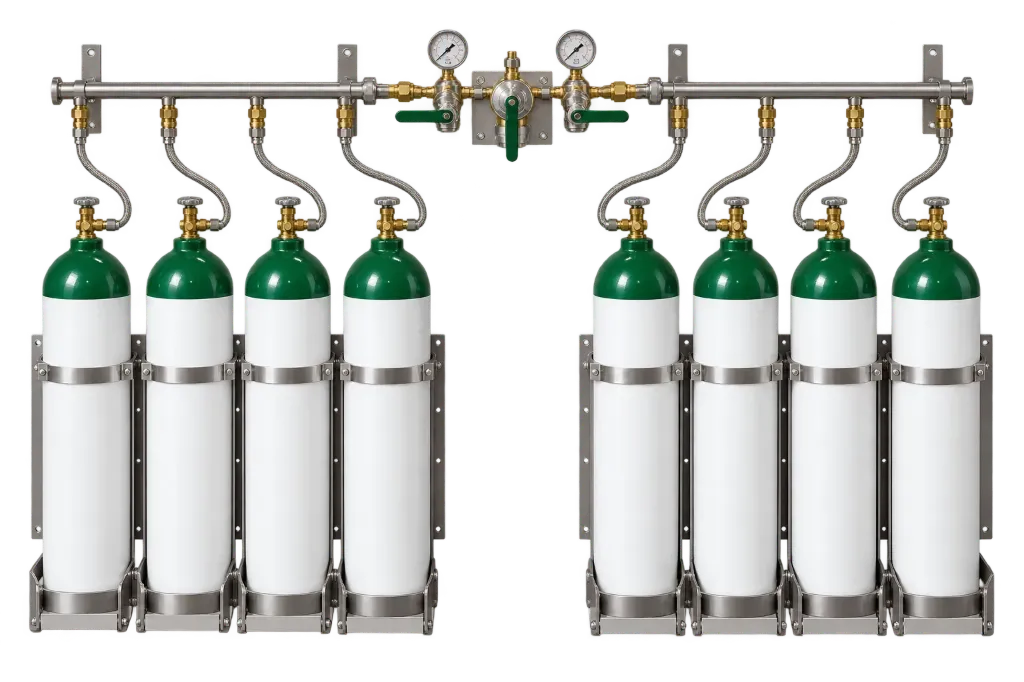
An oxygen manifold 4×2 is a medical gas supply system designed to connect and manage two banks of four oxygen cylinders, providing a controlled supply of medical oxygen to a healthcare facility's pipeline system. The configuration is commonly used where multiple cylinders are required to provide a continuous or reserve oxygen supply.
A 4×2 oxygen manifold with pigtail can be supplied with cylinder connection pigtails, pressure gauges, valves and other components required for connection to oxygen cylinders. Depending on the installation, the system may be manual or automatic changeover.
Kenyan hospital medical-gas specifications include 4×2 oxygen manifold systems with cylinder banks, pressure monitoring, cylinder connection tails and automatic changeover configurations.
An oxygen manifold 4×2 is a manifold arrangement designed for eight oxygen cylinders in two banks of four.
The two-bank configuration allows one bank to supply oxygen while the other bank can serve as the reserve, depending on the manifold design. In an automatic changeover system, the supply can switch between cylinder banks when the primary bank reaches its changeover condition.
A Kenyan medical-gas tender specification describes a 4×2 pure oxygen cylinder-bank manifold with automatic changeover and a control panel for hospital medical-gas distribution.
A 4×2 oxygen manifold with pigtail combines the manifold assembly with flexible cylinder connection tails that connect individual oxygen cylinders to the manifold.
Depending on the configuration, the assembly may include:
Oxygen manifold header
Cylinder connection pigtails
Cylinder isolation valves
Pressure gauges
Pressure regulators
Changeover mechanism
Control panel
Cylinder brackets or supports
High-pressure connections
Outlet connection to the medical oxygen pipeline
Safety and pressure-relief components where specified
A Kenyan hospital tender specifies a 4×2 oxygen manifold with a two-stage pressure gauge and flexible cupronickel cylinder connection tail.
An oxygen manifold with cylinder bracket in Kenya provides both the manifold connection system and a means of securing oxygen cylinders in the designated installation area.
Cylinder brackets or supports help keep cylinders correctly positioned and secured during operation. The exact bracket arrangement depends on cylinder size, manifold design and installation requirements.
Current Kenyan supplier listings include a 4×2 oxygen manifold with pigtail and cylinder bracket as a complete medical-gas product.
A medical oxygen manifold in Kenya is typically installed as part of a hospital medical gas system. It connects oxygen cylinders to a controlled distribution system that can supply medical oxygen to downstream pipeline outlets.
Typical applications include:
Hospitals
Referral hospitals
Maternity facilities
Intensive care units
Operating theatres
Emergency departments
Clinics
Medical centres
Healthcare facilities requiring cylinder-based oxygen supply
For larger healthcare projects, the manifold is normally installed, tested and commissioned as part of the overall medical gas pipeline system.
An oxygen manifold system can include several interconnected components that work together to control the supply of oxygen from cylinder banks.
The 4×2 configuration provides two banks, each containing four cylinders.
High-pressure pigtails connect individual cylinders to the manifold header.
Gauges provide pressure readings for monitoring the cylinder-bank and supply conditions.
Automatic systems can change supply from one cylinder bank to the other according to the system's operating configuration.
An automatic manifold may include a control panel for system status and operating indications.
The manifold connects to the downstream medical oxygen pipeline or designated supply line.
Depending on the specific model, an oxygen manifold system may include:
4×2 cylinder-bank configuration
Two oxygen cylinder banks
Four cylinders per bank
Oxygen-compatible pigtails
Automatic or manual changeover
Pressure regulation
Cylinder brackets
Pipeline outlet connection
Alarm interfaces on selected systems
Wall-mounted or floor-mounted installation
Testing and commissioning provisions
The exact components should be confirmed from the manufacturer's technical specification and the project design.
A 4×2 oxygen manifold can be used where a healthcare facility requires a centralized cylinder-based oxygen supply.
Common applications include:
For supplying oxygen to a medical gas pipeline.
To support oxygen delivery infrastructure serving critical-care areas.
For medical gas distribution to theatre outlets.
For oxygen supply to designated neonatal and maternity areas.
For centralized oxygen availability through pipeline outlets.
For facilities using cylinder banks as their primary or backup oxygen source.
A typical 4×2 system operates through two oxygen cylinder banks.
Oxygen cylinders are connected to the appropriate manifold pigtails.
Each cylinder is secured using the designated support or bracket.
Cylinder valves are opened according to the installation procedure.
The manifold receives oxygen from the active cylinder bank.
Pressure is monitored using the system gauges.
The manifold regulates the supply pressure as designed.
Oxygen is delivered to the medical gas pipeline.
In an automatic system, the changeover mechanism transfers supply to the reserve bank according to its operating settings.
The depleted cylinder bank can then be replaced or replenished.
Installation and commissioning should be performed by qualified medical-gas professionals. Kenyan project specifications explicitly include testing and commissioning of medical gas pipeline systems.
Medical oxygen is an oxidizing gas and requires appropriate handling.
Important precautions include:
Installation should be performed by qualified medical-gas technicians.
Use components specifically designed and approved for oxygen service.
Keep oxygen equipment away from flames, sparks and sources of ignition.
Do not use oil, grease or other incompatible substances on oxygen connections.
Secure cylinders properly.
Check pigtails and connections for damage before use.
Use the correct cylinder connections and fittings.
Do not modify pressure settings without authorization.
Carry out appropriate leak testing.
Follow the manufacturer's installation and maintenance instructions.
Test and commission the completed system before clinical use.
Maintain appropriate warning labels and safety procedures.
The manifold should be treated as part of the medical gas installation rather than as an ordinary plumbing assembly.
The oxygen manifold 4×2 price in Kenya depends on the manifold configuration, pigtails, cylinder brackets, pressure gauges, changeover system, control panel and other accessories.
A current Kenyan supplier lists a Manifold 4×2 with pigtail and cylinder bracket for oxygen at approximately KSh 432,000.
This should be treated as a current supplier listing rather than a universal market price. Installation, testing, commissioning, pipeline connections and additional accessories may be priced separately depending on the project.
When purchasing an oxygen manifold system in Kenya, check the complete specification before ordering.
Consider:
4×2 configuration
Cylinder capacity and size
Pigtail type and material
Cylinder connection standard
Manual or automatic changeover
Operating pressure
Outlet pressure
Alarm functionality
Oxygen compatibility
Pipeline connection
Installation requirements
Testing and commissioning
Spare parts and service support
For hospital installations, the manifold should be selected according to the medical gas design and the facility's oxygen demand.
A 4×2 manifold is intended for two banks of four cylinders. Confirm that this matches the facility's cylinder storage and oxygen-demand requirements.
Manual systems require operator intervention, while automatic systems can transfer supply between cylinder banks according to their control configuration.
Confirm the pigtail connection, material and pressure rating are suitable for the oxygen cylinders being used.
The manifold should have appropriate pressure gauges and monitoring equipment for the intended installation.
Check whether cylinder brackets or other approved supports are included.
For hospital installations, determine whether the system requires local or remote alarm functionality.
Medical gas manifolds should be installed, tested and commissioned as part of the appropriate medical gas system.
Exact pressure ratings, connection standards, dimensions and cylinder compatibility should be confirmed from the manufacturer's technical datasheet before purchase.
A 4×2 oxygen manifold is a cylinder-bank manifold arranged as two banks of four oxygen cylinders, allowing the oxygen supply to be managed through a centralized manifold system.
The 4×2 configuration generally refers to four cylinders in each of two banks, giving a total capacity for eight cylinders.
It is a manifold supplied with flexible high-pressure connection tails used to connect oxygen cylinders to the manifold header.
It is a manifold configuration that includes supports for securing the oxygen cylinders connected to the system.
A current Kenyan supplier lists a 4×2 oxygen manifold with pigtails and cylinder bracket at approximately KSh 432,000. The final project cost can vary depending on configuration, installation and commissioning.
Yes. Automatic 4×2 oxygen manifolds are available. Kenyan hospital specifications include 4×2 oxygen cylinder manifolds with automatic changeover and control panels.
They are commonly used in hospitals, medical centres, maternity units, operating theatres, intensive-care facilities and other healthcare settings requiring centralized oxygen distribution.
Yes. A medical oxygen manifold should be properly installed, tested and commissioned as part of the medical gas system by qualified personnel.
These other products might interest you
Allow the use of cookies from this website on this browser?
We use cookies to provide improved experience on this website. You can learn more about our cookies and how we use them in our Cookie Policy.