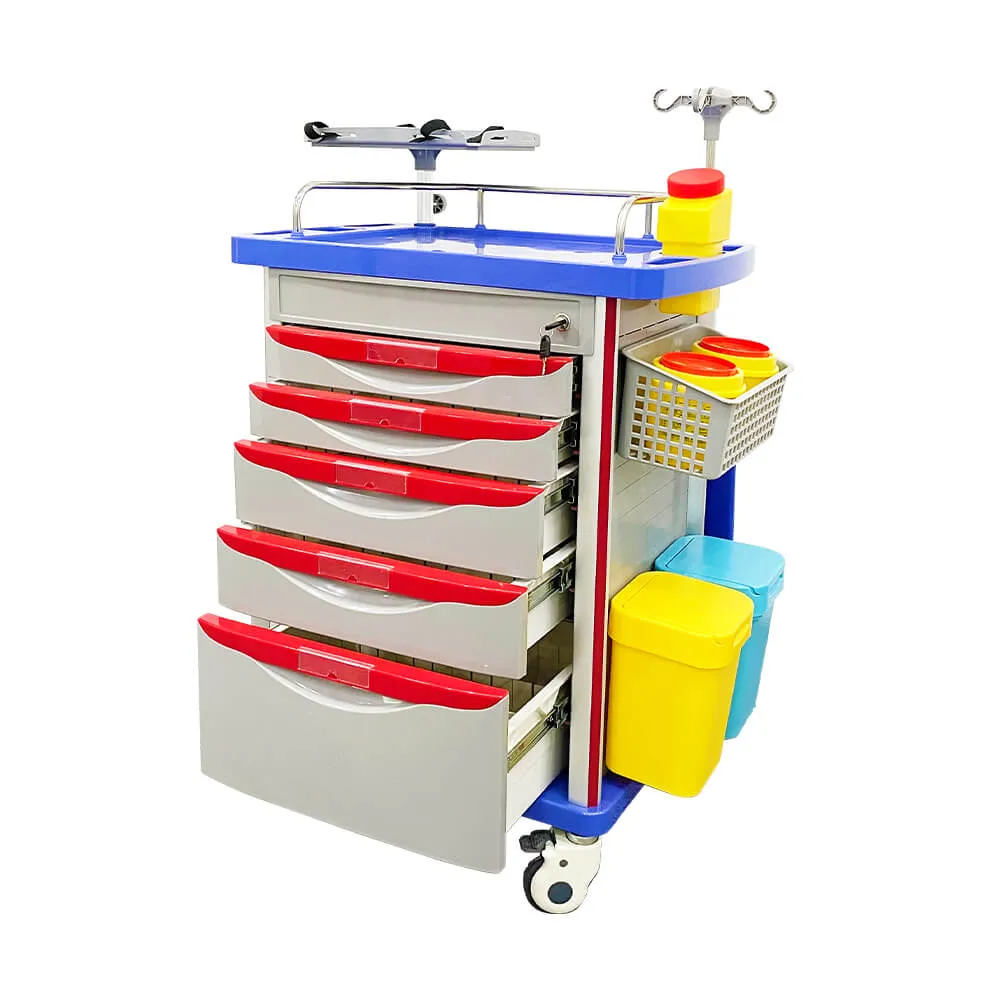
A Crash Cart is a specialized mobile emergency medical trolley designed to store, organize, secure, and transport essential resuscitation equipment, emergency medications, airway management supplies, and other critical care accessories within hospitals and healthcare facilities.
Also known as an emergency crash cart, resuscitation trolley, emergency medical trolley, code blue cart, or hospital emergency cart, this equipment provides healthcare professionals with organized access to the supplies required during cardiac arrest, respiratory emergencies, and other life-threatening medical situations.
A typical emergency crash cart features multiple storage drawers, a durable working surface, a dedicated defibrillator tray or shelf, an intravenous (IV) pole, a cardiopulmonary resuscitation (CPR) board, and swivel caster wheels. Depending on the manufacturer, additional features may include an oxygen cylinder holder, sharps container holder, utility compartments, pull-out writing shelf, centralized locking mechanism, and power outlet accessories.
Crash carts are commonly used in:
Hospital emergency departments
Intensive care units (ICUs)
Operating theatres
High-dependency units (HDUs)
Maternity hospitals
Emergency treatment rooms
Cardiac care units
Outpatient facilities
Dialysis centers
Surgical centers
Other healthcare facilities providing emergency resuscitation services
The primary purpose of a crash cart is to keep appropriate emergency supplies organized and accessible to trained clinical personnel.
Unlike an ordinary instrument trolley or medication cart, a crash cart is specifically configured for emergency response workflows. Its layout, equipment inventory, security system, and restocking procedures should follow the healthcare facility's approved emergency response protocols.
The crash cart price in Kenya depends on the number of drawers, frame material, defibrillator shelf, locking mechanism, caster wheels, included accessories, manufacturer, and overall trolley specifications.
The following advertised prices from other Kenyan medical equipment suppliers provide useful comparisons for emergency crash carts and resuscitation trolleys.
Kenyan Supplier
Product Listing
Advertised Price
Equiplex Medical Supplies – Nairobi marketplace
Medical Crash Cart / Emergency Trolley
KSh 55,000
Medipal Pharmaceuticals
Emergency Crash Cart Trolley, Five Drawers
KSh 58,000
The Farlays Healthcare – Nairobi marketplace
Five-Drawer ABS Emergency Trolley
KSh 64,500
Jomex Medical Supplies
Hospital Crash Cart
KSh 65,000
Hospital Beds Kenya
Emergency Crash Cart
ZanMed Medical Supplies
Emergency Crash Cart / Procedure Trolley
KSh 70,000
Medjet Hospital Supplies
Ultrascope Medical
Emergency Trolley / Crash Cart
Jumia Kenya – Mediplug Equipment
Medical Crash Cart With Emergency Accessories
KSh 74,999
Solution Science
KSh 78,999
Totalease Ventures
Emergency Resuscitation Trolley
KSh 87,000
Paula Medical Solutions
Emergency Trolley
KSh 106,000
These are advertised prices for different crash cart models from other suppliers. They do not represent Maesio Pharmaceuticals' selling price.
The models vary in drawer count, materials, defibrillator support, locking systems, oxygen cylinder holders, accessories, and manufacturing specifications. Advertised prices, availability, and delivery charges may change.
Crash Cart Type
Main Price Considerations
Basic Emergency Trolley
Frame construction, drawer quantity, and mobility
ABS Emergency Crash Cart
Polymer body, aluminum supports, and storage compartments
Stainless Steel Crash Cart
Stainless steel grade, construction, and finish
Five-Drawer Emergency Cart
Drawer sizes, dividers, and locking mechanism
Crash Cart With Defibrillator Tray
Dedicated support tray and equipment mounting
Crash Cart With CPR Board
Integrated or detachable CPR backboard
Crash Cart With Oxygen Holder
Oxygen cylinder bracket and mounting system
Fully Accessorized Crash Cart
IV pole, accessory bins, defibrillator shelf, and other features
Advanced Resuscitation Cart
Specialized storage, security, and manufacturer-specific features
Budget guidance: Comparable emergency crash carts in Kenya are advertised from approximately KSh 55,000, with many multi-drawer models listed between KSh 58,000 and KSh 90,000. Certain specialized configurations cost more.
Buyers should verify exactly which accessories are supplied because a crash cart advertised with a defibrillator tray does not necessarily include the defibrillator itself.
Buy an Emergency Crash Cart Trolley in Kenya from Maesio Pharmaceuticals Limited for hospitals, emergency departments, ICUs, operating theatres, maternity facilities, and surgical centers.
Product: Emergency Crash Cart Trolley – View Product and Order
Supplier: Maesio Pharmaceuticals Limited
Product Category: Hospital Furniture / Emergency Resuscitation Equipment
Configuration: Mobile medical emergency trolley. Confirm drawer count, construction material, defibrillator tray, CPR board, and accessory package for the available model.
Applications: Organized storage of emergency response equipment, medications, and consumables according to institutional protocols.
Delivery: Nairobi and countrywide Kenya, with East African deliveries available by arrangement.
Ordering Advice: Confirm whether the supplied trolley includes a defibrillator shelf, CPR board, IV pole, oxygen cylinder holder, drawer dividers, caster brakes, and centralized locking mechanism.
The crash cart should not be assumed to include a defibrillator, emergency medications, oxygen cylinder, or other medical devices unless those items are explicitly included in the quotation.
If you are looking to buy a crash cart in Nairobi, selecting an appropriately configured resuscitation trolley is important for supporting effective emergency preparedness in healthcare facilities.
A hospital crash cart provides dedicated storage for resuscitation equipment and clinical supplies required by trained healthcare professionals during emergency response.
An organized crash cart allows staff to locate designated supplies efficiently, check inventory, and replenish items according to departmental procedures.
Maesio Pharmaceuticals Limited supplies hospital furniture, emergency medical equipment, operating theatre supplies, and other healthcare products throughout Kenya.
Hospital emergency rooms
Intensive care units
High-dependency units
Recovery rooms
Endoscopy facilities
Dental surgical centers
Specialist medical clinics
Private hospitals
Hospital wards
Emergency treatment facilities
Pediatric emergency departments
Neonatal intensive care units
Ambulatory surgical centers
Healthcare training institutions
The trolley's stocked contents should be determined by the responsible clinical team and adapted to the healthcare facility's patient population, services, and approved emergency response procedures.
An emergency crash cart for sale in Kenya is a mobile storage trolley developed for rapid deployment of emergency supplies during appropriate resuscitation activities.
Its construction generally combines organized drawers with a dedicated worktop and equipment mounting accessories.
Several drawers allow emergency medications, consumables, and clinical accessories to be organized into designated compartments.
A dedicated tray or shelf can support a compatible defibrillator according to the manufacturer's mounting and load specifications.
Selected crash carts include a CPR board stored at the rear or side of the trolley.
An intravenous pole may provide a mounting point for appropriate IV fluids and compatible accessories.
Some models include a bracket for securing an appropriately sized oxygen cylinder.
Central locking or tamper-evident security systems may help control access and identify whether the cart has been opened.
Mobile designs allow trained staff to move the trolley within suitable clinical areas.
Wheel brakes help secure the trolley during stationary use.
Certain models include side containers, removable compartments, sharps holders, and utility bins.
Smooth plastic or metal surfaces support approved clinical cleaning procedures.
A crash cart with defibrillator tray in Kenya includes a dedicated platform intended to support a compatible defibrillator or monitoring device.
The tray is a valuable accessory because it provides a designated location for emergency defibrillation equipment rather than requiring the device to be placed loosely on the trolley worktop.
The tray provides a specific location for positioning a compatible defibrillator.
The defibrillator can be positioned where trained clinical personnel can access it during an emergency.
The tray must be suitable for the device's weight and dimensions.
Suitable cable management and equipment mounting arrangements may help reduce obstruction.
Some trays include retaining lips, straps, or other manufacturer-specific securing features.
Before buying a crash cart with a defibrillator tray, confirm:
Whether the tray is included.
Its dimensions.
Maximum rated weight capacity.
Whether it is fixed, adjustable, or removable.
Whether the intended defibrillator fits.
Whether a retaining mechanism is supplied.
Whether charging or power accessories are included.
Whether the defibrillator is sold separately.
A defibrillator tray is not the same as a defibrillator. A trolley supplied with a tray should not be advertised as including a functioning defibrillator unless this is specifically confirmed.
Choosing a reliable hospital crash cart supplier in Kenya helps healthcare facilities obtain suitable emergency trolley equipment for resuscitation preparedness.
Maesio Pharmaceuticals Limited supplies hospital furniture, emergency equipment, operating theatre products, and clinical supplies across Kenya and East Africa.
The Emergency Crash Cart Trolley can support organized storage and transportation of appropriately stocked emergency supplies within approved healthcare environments.
Hospitals, clinics, nursing facilities, and medical institutions can explore emergency equipment, resuscitation accessories, hospital furniture, and related healthcare products through www.maesiopharmaceuticals.co.ke.
Drawer quantity: Confirm the number and size of drawers.
Construction material: Verify ABS, stainless steel, aluminum, or hybrid construction.
Defibrillator shelf: Confirm whether it is included.
Defibrillator compatibility: Check tray dimensions and load rating.
CPR board: Verify whether a detachable board is supplied.
IV pole: Confirm inclusion and specifications.
Oxygen cylinder holder: Check compatibility with the intended cylinder.
Locking system: Determine the security mechanism.
Drawer dividers: Verify adjustable compartments and labels.
Caster wheels: Check the size and swivel function.
Wheel brakes: Confirm the number of lockable wheels.
Waste compartments: Verify compatible accessory containers.
Overall dimensions: Measure the space available in the department.
Cleaning compatibility: Check approved disinfectants.
Replacement parts: Ask about locks, drawers, wheels, and accessories.
Warranty: Request applicable terms.
Bulk procurement: Obtain quotations for institutional quantities.
Delivery: Confirm transportation and assembly arrangements.
For institutional tenders, request the manufacturer's technical datasheet before approving the trolley.
An ABS crash cart generally combines molded plastic panels or work surfaces with a reinforced metal supporting structure.
These carts often feature multiple drawers, accessory holders, and swivel caster wheels.
A stainless steel crash cart uses corrosion-resistant metal components for its body, frame, or work surfaces.
Suitability depends on the steel grade, overall construction, and cleaning requirements.
A five-drawer trolley provides multiple storage levels that may be organized according to the facility's emergency inventory system.
This model includes a dedicated shelf or tray intended for compatible defibrillation equipment.
Selected crash carts have a removable CPR board attached to the side or rear of the trolley.
Certain models include an integrated holder for an appropriately sized medical oxygen cylinder.
A pediatric crash cart is organized for the equipment and supplies required by authorized pediatric emergency response teams.
Advanced configurations may include specialized drawers, secure medication access, integrated accessories, and expanded equipment mounting options.
The drawers provide separate storage compartments for medications, airway accessories, consumables, and other approved emergency supplies.
Crash carts are commonly manufactured using ABS plastic, aluminum, steel, stainless steel, or hybrid materials.
Selected models provide a specific platform for a compatible defibrillator.
A removable CPR board may be provided as part of the accessory package.
Some crash carts include a central lock or tamper-evident system to help manage access.
Internal organizers help separate different categories of supplies.
Four swivel casters are common on modern mobile emergency carts.
Wheel brakes help prevent movement while the trolley is in a stationary working position.
An integrated or removable IV pole may support approved intravenous accessories.
A secured holder can accommodate a manufacturer-compatible medical oxygen cylinder.
Side compartments and removable bins can provide storage for suitable clinical accessories.
The upper surface provides space for appropriate equipment preparation and organization.
A dedicated emergency cart provides an organized storage location for essential response supplies.
Clearly labeled drawers help trained personnel identify and retrieve required materials.
Standardized compartments support stock checks, expiration-date reviews, and replenishment.
Caster wheels let staff move the trolley to appropriate patient care locations.
Locking systems can help facilities control access to stored emergency medications.
A compatible defibrillator tray offers a designated platform for the device.
Consistent trolley layouts help staff follow the institution's established emergency procedures.
Crash carts may be used in emergency rooms, ICUs, HDUs, operating theatres, and other approved clinical areas.
Feature
ABS Crash Cart
Main Construction
ABS polymer with supporting frame
Stainless steel components
Appearance
Molded medical cart panels
Metallic surface finish
Weight
Model dependent
Drawer Configuration
Multiple available
Corrosion Resistance
ABS does not rust
Depends on steel grade
Cleaning
Compatible plastic-safe products
Compatible metal-safe products
Defibrillator Shelf
Mobility
Usually caster-mounted
Locking System
Available
Hospital Applications
Emergency and critical care
An ABS crash cart may be appropriate where buyers prefer molded work surfaces, organized drawers, and a particular accessory layout.
A stainless steel cart may be preferable where a metal construction and specific cleaning requirements are priorities.
Neither material guarantees superior performance without considering the manufacturer's complete specifications.
Crash Cart
Anaesthesia Cart
Main Purpose
Emergency resuscitation supply organization
Anesthesia medication and equipment organization
Primary Location
Emergency departments, wards, ICUs, theatres
Operating theatres and anesthesia areas
Defibrillator Tray
Common on selected models
Not universally included
CPR Board
Medication Storage
Emergency-response supplies
Anesthesia-related supplies
Drawers
Commonly multiple
Security
Locking or tamper-evident systems
Medication locking systems
Stocking Protocol
Emergency response team
Anesthesia department
A crash cart should not be substituted for an anesthesia cart, or vice versa, without confirming that the equipment and stocked contents meet the facility's intended use.
Instrument Trolley
Main Function
Emergency supplies storage
Instrument and consumable transportation
Storage
Multiple drawers and accessory holders
Commonly open shelves
Generally not standard
Medication Security
Often provided
Swivel casters
Typical Application
Emergency resuscitation
Routine and procedural clinical work
A standard instrument trolley does not automatically provide the storage configuration or dedicated emergency accessories of a crash cart.
A crash cart and a defibrillator are separate medical products.
Defibrillator
Primary Purpose
Storage and transportation
Electrical defibrillation when clinically indicated
Function
Organizes emergency supplies
Delivers controlled electrical therapy
Electrical Power
Usually not required for manual cart
Required
Commonly included
Not applicable
May be included
Device may be mounted on a compatible tray
Clinical Operation
Mobile furniture
Operated according to device instructions and clinical protocols
Purchase
Cart and accessories
Medical device, usually separately supplied
When planning a complete hospital resuscitation station, confirm separately whether the quotation includes an automated external defibrillator (AED), a manual defibrillator, or neither.
Emergency departments require equipment that supports organized access to designated supplies during urgent clinical situations.
A crash cart can provide a central storage location for the emergency response team's approved inventory.
Drawers can be labeled to identify different categories of equipment and consumables.
A compatible shelf can support a designated defibrillator at an accessible workstation.
Approved airway management accessories may be organized in dedicated compartments.
Emergency medications must be stored under appropriate conditions and security controls.
The responsible clinical team should inspect the cart according to the facility's emergency readiness procedures.
Intensive care units may require emergency resuscitation supplies immediately accessible to trained personnel.
A crash cart provides a designated storage location for the facility's approved emergency equipment.
The trolley can be moved to an appropriate bedside location when required.
A consistent layout can support inventory checks and familiarization.
ICU teams should maintain a documented inspection and replenishment process.
The trolley itself does not replace critical care monitors, ventilators, or other life-support devices.
Operating theatres and recovery areas may require dedicated emergency carts as part of their resuscitation readiness arrangements.
A crash cart provides organized emergency supplies separate from routine surgical instrument storage.
Recovery units may use a suitable cart for designated emergency response supplies.
Obstetric theatres can use crash carts configured according to their approved emergency protocols.
The cart should remain accessible, appropriately stocked, securely positioned, and maintained according to institutional requirements.
Clinics, medical centers, and smaller hospitals should select emergency equipment according to the services they provide, staffing, patient population, and regulatory requirements.
A crash cart may be appropriate for facilities with trained personnel and established emergency response procedures.
Available space
Clinical services provided
Staff emergency response training
Availability of a compatible defibrillator
Required emergency medications and supplies
Medication storage and security
Equipment maintenance
Emergency referral arrangements
Inspection and restocking responsibilities
Purchasing a crash cart alone does not establish a complete emergency response capability.
Before purchasing an emergency crash cart, consider the following:
Clinical application: Identify the intended department and patient population.
Drawer quantity: Confirm how many compartments are required.
Drawer sizes: Check usable internal dimensions.
Defibrillator tray: Confirm compatibility with the intended device.
CPR board: Verify whether it is included.
IV pole: Check for compatibility and loading requirements.
Oxygen cylinder holder: Confirm the supported cylinder size.
Drawer locking: Choose an appropriate security mechanism.
Internal dividers: Check whether compartments can be rearranged.
Caster wheels: Verify wheel size and maneuverability.
Brakes: Confirm reliable stationary positioning.
Worktop: Check the dimensions and raised edges.
Accessory containers: Determine which items are included.
Maximum load: Request manufacturer-rated capacities.
Cleaning compatibility: Verify approved disinfectants.
Replacement parts: Check availability of wheels, locks, and accessories.
Warranty: Request written warranty terms.
Assembly: Confirm whether the trolley arrives ready for use.
Delivery: Confirm the shipping destination and handling requirements.
For institutional procurement, obtain the exact model datasheet and a written list of included accessories.
The crash cart's internal layout should be determined by authorized clinical personnel.
The emergency response team should define the supplies required for the facility's services.
Clear labels can help staff locate approved equipment categories.
Compartments can reduce mixing and improve inventory management.
Maintain access controls appropriate to the medications stored.
Inspect medications and sterile consumables according to institutional procedures.
Position the defibrillator and other approved attachments according to facility requirements.
Replace consumed supplies after emergency use.
Keep records of the required readiness checks.
Personnel should know where the trolley is located, how it is secured, and who is responsible for maintenance.
An emergency trolley requires routine inspection even when it has not been used.
Inspect the drawers, locks, handles, frame, and caster wheels.
Confirm that the cart's assigned equipment is present according to the facility's approved checklist.
If a defibrillator is assigned to the cart, inspect it according to the device manufacturer's instructions and the facility's testing requirements.
Review stock and expiration dates under the responsible clinical team's procedures.
Check the cart's security system and tamper-evident seals where fitted.
Keep the trolley in its designated location with a clear route for emergency deployment.
The inspection schedule should be set by the facility's emergency readiness policy. Certain checks may be required daily or at other defined intervals.
Regular cleaning and preventive maintenance help keep the trolley functional and suitable for clinical use.
Remove appropriate items before cleaning.
Clean visible contamination.
Use manufacturer-approved detergents.
Apply compatible disinfectants where required.
Follow the specified contact time.
Allow surfaces to dry.
Inspect drawers for spills or contamination.
Clean accessible compartments.
Check drawer runners.
Replace damaged labels.
Inspect dividers and storage trays.
Remove debris from wheels.
Check smooth swivel movement.
Inspect wheel attachments.
Test braking mechanisms.
Replace damaged components with suitable parts.
Verify the security mechanism works.
Inspect keys, seals, or other access controls.
Report damaged locks.
Follow medication security procedures.
Check the defibrillator shelf.
Inspect CPR board mounting points.
Verify IV pole stability.
Check oxygen cylinder holder attachments.
Inspect side containers and accessory brackets.
Arrange immediate repair, replacement, or an approved substitute if:
The trolley is structurally unstable.
Drawers cannot be accessed reliably.
The security mechanism malfunctions.
Wheels or brakes become unsafe.
The defibrillator tray is loose or damaged.
Critical accessories cannot be secured.
Sharp edges or damaged panels create hazards.
The cart cannot be properly cleaned.
The healthcare facility should maintain an appropriate alternative emergency equipment arrangement while an essential cart is unavailable.
Comparable emergency crash carts are advertised by Kenyan suppliers from approximately KSh 55,000, with many models priced between KSh 58,000 and KSh 90,000. Prices depend on construction, drawer configuration, accessories, and manufacturer.
You can order an Emergency Crash Cart Trolley through Maesio Pharmaceuticals Limited for hospitals, emergency departments, ICUs, operating theatres, and medical clinics.
A crash cart is a mobile medical trolley used to store and transport emergency resuscitation supplies and equipment.
Other names include emergency trolley, resuscitation trolley, code blue cart, and emergency medical cart.
Yes. Kenyan medical equipment suppliers offer crash carts in different drawer configurations and construction materials.
It is an emergency trolley equipped with a dedicated platform for a compatible defibrillator.
Not necessarily. A defibrillator is usually a separate medical device unless specifically included in the supplied package.
A crash cart stores and transports supplies, while a defibrillator is a medical device that delivers electrical therapy when clinically indicated.
Many commercially available models feature five drawers, although other configurations are available.
Some models use ABS plastic panels or drawers with metal supporting structures.
Yes. Stainless steel and mixed-material emergency trolleys are available.
Many models include caster brakes. Confirm the configuration before purchasing.
Some emergency trolleys include a detachable CPR board, while others may offer it as an accessory.
Selected models include a compatible oxygen cylinder holder. The cylinder itself may be sold separately.
Some models include an IV pole as standard equipment or an optional accessory.
Do not assume so. Most hospital furniture quotations should be checked separately for any medications, equipment, or consumables included.
Yes. Crash carts are commonly used for emergency preparedness in intensive care units.
Yes, provided the cart and its stocked contents meet the maternity facility's approved emergency response requirements.
Crash carts are organized for emergency resuscitation, while anesthesia trolleys are generally configured for anesthesia-related supplies and medications.
They may be appropriate depending on the clinic's services, staffing, emergency protocols, and equipment requirements.
A conventional mobile storage cart generally does not require electricity, although devices mounted on it may require power.
A centralized locking system helps secure multiple drawers and control access to stored items.
A CPR board is an accessory used in certain resuscitation procedures according to the responsible clinical team's protocols.
Mobile crash carts can be repositioned, but facilities should maintain their designated emergency equipment locations and readiness procedures.
The schedule depends on the healthcare facility's policy. Inspections should include equipment readiness, inventory, expiration dates, locks, and physical condition.
Yes, when medications are stored under appropriate temperature, security, labeling, and institutional medication-management requirements.
Replacement components may be available depending on the manufacturer and model.
Yes. Hospitals, surgical centers, medical institutions, and healthcare groups can request quotations for multiple units.
Maesio Pharmaceuticals supplies customers across Kenya and can arrange delivery to East African destinations, subject to shipping confirmation.
Confirm the drawer count, construction materials, defibrillator shelf, CPR board, IV pole, oxygen holder, locking system, wheels, brakes, warranty, and whether emergency equipment is included.
Specification
Details
Product Name
Emergency Crash Cart Trolley
Alternative Names
Crash Cart, Emergency Resuscitation Trolley, Code Blue Cart, Hospital Emergency Trolley
Product Category
Hospital Furniture / Emergency Resuscitation Equipment
Product Type
Mobile emergency medical storage trolley
Organization and transport of approved emergency equipment and supplies
Construction Material
ABS, stainless steel, aluminum, or manufacturer-specified combination
Frame Material
Confirm manufacturer's specification
Worktop Material
Manufacturer dependent
Multiple drawers; exact quantity to be confirmed
Five-Drawer Option
Available on comparable models
Internal Drawer Dividers
Drawer Labeling
Centralized Locking
Available on selected models
Tamper-Evident Seals
Available on selected models; confirm inclusion
Defibrillator Included
Not assumed; confirm separately
Defibrillator Tray Dimensions
Defibrillator Tray Load Capacity
Confirm manufacturer-rated capacity
IV Pole
Oxygen Cylinder Holder
Oxygen Cylinder Included
Not assumed
Sharps Holder
Waste Container
Side Storage Compartments
Pull-Out Shelf
Power Outlet Accessories
Caster Wheels
Commonly four swivel casters
Wheel Brakes
Confirm selected configuration
Overall Length
Overall Width
Overall Height
Maximum Cart Load
Drawer Load Capacity
Worktop Load Capacity
Manufacturer-approved clinical cleaning procedures
Electrical Requirement
Generally not required for conventional cart operation
Emergency Medications Included
Airway Equipment Included
Intended Applications
Hospitals, emergency departments, ICUs, HDUs, operating theatres, maternity units, and surgical centers
Warranty
Confirm applicable supplier terms
Assembly
Confirm supplied configuration
Availability
Subject to stock and model confirmation
Delivery
Nairobi, countrywide Kenya, and East Africa by arrangement
These specifications describe the Emergency Crash Cart Trolley product category. The exact Maesio product configuration, materials, drawer count, defibrillator tray, CPR board, and supplied accessories should be confirmed before purchasing.
These other products might interest you
Allow the use of cookies from this website on this browser?
We use cookies to provide improved experience on this website. You can learn more about our cookies and how we use them in our Cookie Policy.