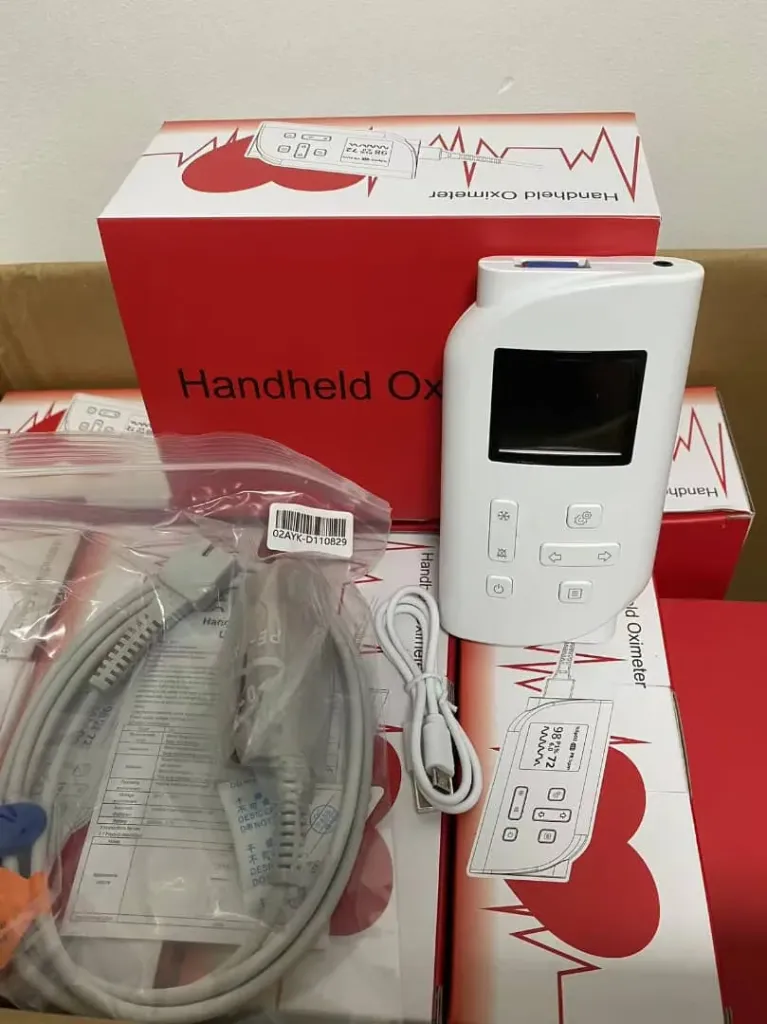
A handheld pulse oximeter is a portable medical monitoring device used to measure estimated blood oxygen saturation (SpO₂) and pulse rate. Unlike basic fingertip-only units, handheld models commonly use an external SpO₂ probe connected to the main display unit, making them useful for clinical spot checks, patient observation, transport and home-based monitoring.
The hand held pulse oximeter is particularly useful where healthcare providers need a portable monitor that can accommodate different probe options. Depending on the model, probes may be available for adults, children and neonates. The CONTEC CMS60D, for example, supports external oximeter probes and displays SpO₂, pulse rate and pulse waveform.
A handheld pulse oximeter measures SpO₂ and pulse rate using a sensor placed on the finger or another compatible measurement site. The device receives information from the external probe and presents the readings on its digital display.
Handheld models can be useful in:
Hospitals and clinics
Wards and outpatient departments
Emergency and recovery areas
Ambulances and patient transport
Home-based care
Community healthcare
Routine clinical spot checks
The exact intended use depends on the manufacturer's specifications and the probe supplied.
A hand held pulse oximeter consists of a compact display unit and a compatible SpO₂ probe. This configuration can offer more flexibility than a simple fingertip unit, particularly when different probe sizes are required.
For example, CONTEC's CMS60D can connect to an external oximeter probe and includes SpO₂ and pulse-rate displays, a pulse waveform display, review functions and data storage.
Some configurations are available with multiple probes. A CMS60D configuration listed by CONTEC includes adult, slender-finger and little-finger probes.
A portable pulse oximeter is designed for monitoring away from a fixed bedside monitor. Its compact form makes it practical for clinical rounds, patient transfers and situations where a full multi-parameter monitor is unnecessary.
Depending on the model, portable handheld oximeters may offer:
Colour digital display
SpO₂ measurement
Pulse-rate measurement
Pulse waveform or plethysmograph
Audible pulse indication
Adjustable alarms
Data review
Data storage
External probe connection
Battery operation or rechargeable power
These features vary between manufacturers and models, so the exact configuration should be checked before purchase.
A digital handheld pulse oximeter provides numerical readings on an electronic display, allowing the user to view SpO₂ and pulse rate without relying on an analogue gauge.
Some models also show a pulse waveform and bar graph. CONTEC's CMS60D documentation lists SpO₂, pulse rate, pulse waveform, review functions, battery indication and stored-data functions.
A handheld SpO2 monitor is commonly used for non-invasive monitoring of estimated peripheral oxygen saturation and pulse rate.
The SpO₂ value represents an estimate of oxygen saturation in the blood and should be interpreted alongside the patient's clinical condition. Pulse oximeters are monitoring devices and should not be used as the sole basis for diagnosing a medical condition.
For concerning symptoms or unexpectedly low readings, repeat the measurement correctly and seek appropriate medical assessment rather than relying only on the device reading.
Measures estimated peripheral oxygen saturation through a compatible sensor.
Displays the patient's pulse rate and, on some models, a pulse waveform or pulse bar.
The handheld design allows the main unit to be connected to a separate SpO₂ probe.
A compact handheld format makes the device convenient for wards, clinics, transport and home-care environments.
Provides easy-to-read numerical readings and, depending on the model, waveform and other monitoring information.
Some handheld models provide data review and storage functions. CONTEC's CMS60D supports stored SpO₂ and pulse-rate data and computer data transfer.
Certain configurations can accommodate adult and smaller-finger probes. Exact probe availability depends on the model and package.
Handheld pulse oximeters are commonly used by trained healthcare professionals in:
Hospitals
Medical clinics
Emergency-care settings
Ambulances
Recovery areas
Home-care services
Community healthcare settings
Some models and probe configurations may support adults, paediatric patients and neonates. Always confirm that the specific probe is appropriate for the patient's age and size.
Check that the pulse oximeter and probe are clean and in good condition.
Connect the appropriate SpO₂ probe to the handheld unit.
Turn on the device.
Place the probe correctly on the patient's finger or the measurement site specified by the manufacturer.
Keep the patient and measurement site reasonably still.
Allow the reading to stabilize.
Observe the SpO₂ and pulse-rate readings.
Remove the probe after measurement and clean it according to the manufacturer's instructions.
Movement, poor peripheral circulation, cold extremities, incorrect probe positioning and other factors can affect pulse-oximeter readings.
The handheld pulse oximeter price in Kenya varies according to brand, model, probe configuration, display, data functions and whether the package includes additional probes.
Current Kenyan listing examples include:
CONTEC CMS60D Handheld Pulse Oximeter – KSh 21,000 from Maesio Pharmaceuticals. The listing describes a handheld model with colour display, waveform display, rechargeable power and adult, paediatric and neonatal probe compatibility.
CONTEC CMS60D Handheld Pulse Oximeter – KSh 17,000 in a current Nairobi marketplace listing.
Generic handheld pulse oximeter with paediatric, neonatal and adult probes – KSh 25,000 on a current Kenyan marketplace listing.
A Kenya medical-equipment pricing guide published in 2026 lists handheld pulse oximeters from approximately KSh 10,000, illustrating the variation between models and suppliers.
These are current supplier/listing examples rather than a universal market price. The final price can vary according to brand, probe package, warranty, accessories and supplier.
Before buying a handheld SpO2 monitor, consider:
Intended patient population
Adult, paediatric or neonatal probe requirements
SpO₂ and pulse-rate measurement
Display type and readability
Pulse waveform availability
Data storage and review
Alarm functions
Battery or rechargeable power
External probe compatibility
Replacement-probe availability
Warranty and after-sales support
For healthcare facilities, it is especially useful to confirm the availability of compatible replacement probes before purchasing.
A handheld pulse oximeter and a fingertip pulse oximeter both measure SpO₂ and pulse rate, but their physical configurations differ.
The appropriate type depends on the intended patient population and monitoring requirements.
Important: Exact measurement ranges, accuracy, battery life, dimensions, weight and included accessories are model-dependent. Confirm the specifications of the exact unit being supplied.
A handheld pulse oximeter is a portable device that measures estimated blood oxygen saturation (SpO₂) and pulse rate using an external sensor or probe.
A handheld pulse oximeter normally has a separate display unit connected to an external probe, while a fingertip pulse oximeter integrates the sensor into the small device that clips onto the finger.
It primarily measures estimated oxygen saturation (SpO₂) and pulse rate. Some models also display a pulse waveform and provide data storage or review functions.
Some models can be used with paediatric probes. The exact age suitability depends on the manufacturer and the probe supplied. Do not assume that an adult probe is suitable for a child.
Certain models support neonatal probes, but neonatal use should only be considered where the specific device and probe are expressly intended for that population.
Current Kenyan examples checked include approximately KSh 17,000–25,000 for several handheld models, while other suppliers list models from around KSh 10,000. Price depends on brand, configuration and included probes.
Many handheld designs use an external probe. Some models are supplied with one probe, while other packages include multiple probes for different patient groups.
Many handheld pulse oximeters are designed for clinical environments, but suitability depends on the exact model, intended use, accessories and facility requirements.
These other products might interest you
Allow the use of cookies from this website on this browser?
We use cookies to provide improved experience on this website. You can learn more about our cookies and how we use them in our Cookie Policy.