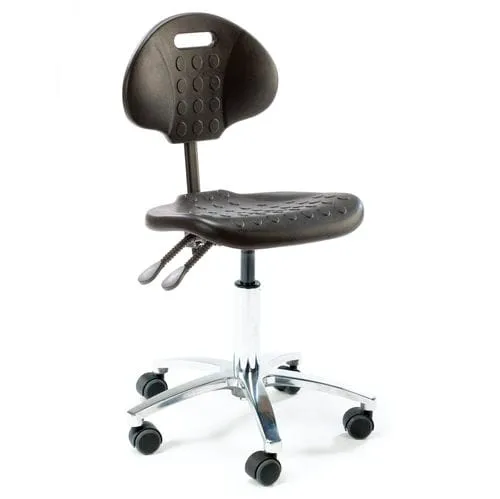
A Laboratory Stool / Chair is a specialized seating solution designed to provide comfortable, adjustable, and practical support for laboratory technicians, scientists, researchers, pharmacists, medical professionals, and other personnel working at laboratory benches and clinical workstations. Also known as a laboratory chair, adjustable lab stool, ergonomic laboratory chair, medical laboratory stool, or laboratory chair with backrest, this equipment combines compact seating with features suited to laboratory activities.
Laboratory stools are commonly designed with adjustable seat heights, stable supporting bases, and easy-to-clean seating surfaces. Depending on the model, they may include cushioned seats, adjustable backrests, 360-degree swivel mechanisms, footrests, and caster wheels. These features allow users to position themselves appropriately when working with microscopes, laboratory analyzers, specimen preparation equipment, and other laboratory instruments.
Unlike conventional office chairs, laboratory stools are selected according to the height of the laboratory workbench, the tasks being performed, and the facility's cleaning and safety requirements. Specialized laboratory seating may also provide chemical-resistant surfaces, antistatic materials, or electrostatic discharge (ESD) protection for environments requiring these features.
The laboratory stool price in Kenya depends on the adjustment mechanism, seat and backrest design, frame construction, upholstery material, footrest configuration, wheel system, maximum weight capacity, and manufacturer.
The following Kenyan supplier listings provide market price references for laboratory stools, adjustable medical chairs, and comparable clinical seating.
Product Listing
Advertised Price
Summer Health Medical Supplies – Adjustable Lab/Salon Stool
KSh 5,000
Medjet Hospital Supplies – Adjustable Doctor Stool With Backrest
KSh 11,000
Tiba Quip Africa – Laboratory Chair / Doctor's Stool
KSh 11,499
Caltech Meds Limited – Adjustable Doctor's Stool
KSh 13,000
MidKen Medical Equipment Supplies – Doctor's Stool
KSh 13,500
Paula Medical Solutions – Medical Stool With Backrest
KSh 16,500
MidKen Medical Equipment Supplies – Stool With Backrest
Kenty Furniture Kenya – Ergonomic Lab Stool
KSh 19,500
These listings represent different seating products and configurations. Basic laboratory stools, general medical stools, and ergonomic laboratory chairs with backrests may have significantly different specifications.
For example, the ergonomic laboratory stool advertised by Kenty Furniture includes a rotating base, adjustable height, integrated leg rest, and backrest support, while some basic adjustable stools may not have backrests.
The final purchase price may vary depending on the seat-height range, upholstery material, supporting frame, adjustment functions, availability, and delivery requirements.
Laboratory Stool Type
Main Price Consideration
Basic Laboratory Stool
Simple seating with limited adjustment
Adjustable Laboratory Stool
Height-adjustment mechanism and seat construction
Laboratory Stool With Backrest
Additional back support and adjustment features
Ergonomic Laboratory Chair
Backrest design, footrest, and multiple adjustments
Laboratory Swivel Stool
Rotation mechanism and supporting base
Antistatic Laboratory Chair
Verified ESD properties and specialized materials
Heavy-Duty Laboratory Stool
Manufacturer-rated load capacity and reinforced construction
Budget guidance: Basic adjustable laboratory stools are advertised from approximately KSh 5,000, while selected laboratory chairs and medical stools with backrests are listed around KSh 11,000–19,500. These prices are market references rather than quotations for identical products.
For institutional purchases, verify the seat-height adjustment range, backrest, upholstery, foot support, maximum working load, and suitability for the intended laboratory environment.
Buy a Laboratory Stool / Chair in Kenya from Maesio Pharmaceuticals Limited for hospitals, medical laboratories, research institutions, diagnostic centers, pharmacies, and healthcare facilities.
Product: Laboratory Chair – Adjustable Professional Laboratory Seating
Product Availability: Confirm the available model and technical specifications before ordering.
Supplier: Maesio Pharmaceuticals Limited
Delivery: Nairobi and countrywide Kenya, with East African delivery arrangements available upon request.
Ordering Advice: Confirm the laboratory stool configuration, adjustable height range, backrest design, seat material, preferred base, footrest requirements, and delivery location before purchasing.
If you are looking to buy a lab chair in Nairobi, selecting the right laboratory seating is important for supporting laboratory personnel during routine testing, specimen analysis, research, and diagnostic procedures.
A laboratory chair provides a dedicated seating position for professionals who perform precision tasks at laboratory workstations.
Unlike conventional office seating, laboratory chairs may need to accommodate elevated benches, restricted floor space, frequent movement between instruments, and specialized cleaning requirements.
An adjustable laboratory stool can allow technicians to change their seating height according to the workbench and individual body dimensions.
Maesio Pharmaceuticals Limited supplies laboratory equipment, hospital furniture, and related medical products to healthcare institutions, laboratories, and organizations throughout Kenya.
Hospital medical laboratories
Clinical diagnostic laboratories
Private pathology laboratories
Microbiology laboratories
Hematology laboratories
Clinical chemistry laboratories
Histopathology laboratories
Molecular biology laboratories
Medical research institutions
Pharmaceutical laboratories
Quality control laboratories
University teaching laboratories
Research and development facilities
Blood bank laboratories
Veterinary diagnostic laboratories
Food testing laboratories
Environmental testing laboratories
Industrial testing facilities
Pharmacy preparation areas
When purchasing laboratory chairs in Nairobi, consider the laboratory bench height, intended procedures, duration of seated work, available floor space, and cleaning requirements.
For laboratory environments involving hazardous chemicals, sensitive electronics, or controlled conditions, confirm that the seating meets the relevant material and safety specifications.
An ergonomic laboratory stool for sale in Kenya is designed to provide adjustable support for laboratory personnel working at different bench heights and workstations.
Ergonomic laboratory stools may include adjustable seating height, supportive backrests, integrated footrings, rotating seats, and stable bases.
These features can help users achieve a more comfortable seated position while performing suitable laboratory activities.
However, ergonomic design alone does not guarantee comfort for every individual. Proper adjustment, workstation dimensions, and regular movement remain important.
Many ergonomic laboratory stools include pneumatic gas-lift systems that allow users to adjust the seat height.
The appropriate adjustment range depends on the workbench and the user's body dimensions.
A laboratory chair with backrest provides an additional surface for supporting the lower or middle back.
Some designs allow vertical or horizontal backrest adjustment.
Higher laboratory stools may feature a circular footring or dedicated foot support.
This provides a resting surface for the feet when the seat height prevents them from reaching the floor comfortably.
A rotating seat allows the user to turn between nearby instruments and work surfaces.
A suitable base helps maintain chair stability during normal seated work.
Many adjustable stools use five-point bases.
Laboratory stools often have smaller footprints than conventional office chairs, making them practical for laboratory workstations.
Laboratory seating may incorporate synthetic upholstery, polyurethane, molded plastic, or other materials selected for the intended environment.
The exact material should be compatible with the facility's cleaning procedures.
Choosing a reliable adjustable lab stool supplier in Kenya helps laboratories, hospitals, research institutions, and universities obtain seating suitable for their technical workspaces.
Maesio Pharmaceuticals Limited supplies laboratory equipment, diagnostic products, hospital furniture, and related institutional supplies across Kenya and the wider East African region.
The Laboratory Stool / Chair can be considered for medical laboratories, hospital diagnostic departments, research facilities, and other workspaces requiring specialized seating.
Customers can explore laboratory supplies, medical equipment, and related hospital furniture through the Maesio Pharmaceuticals online shop.
Laboratory application: Confirm that the chair is suitable for the intended working environment.
Seat-height range: Verify compatibility with the laboratory bench.
Adjustment mechanism: Confirm pneumatic or mechanical height adjustment.
Backrest: Check whether the chair includes adjustable back support.
Seat material: Verify the upholstery or molded seating material.
Chemical resistance: Request material compatibility information where necessary.
ESD protection: Confirm tested antistatic or ESD properties if required.
Footrest: Determine whether the chair includes an adjustable footring.
Swivel function: Verify rotation capability.
Base construction: Confirm the supporting frame material.
Caster wheels: Check wheel design and flooring compatibility.
Weight capacity: Request the manufacturer's maximum rated user load.
Dimensions: Obtain the seat diameter, seat height, and base measurements.
Cleaning: Confirm compatibility with approved laboratory cleaning products.
Warranty: Request written warranty terms.
Replacement parts: Ask about gas lifts, casters, and upholstery components.
Bulk procurement: Request a quotation for institutional quantities.
Delivery: Confirm transportation and assembly requirements.
For hospital and research laboratory tenders, compare the manufacturer's technical documentation with the complete procurement specifications.
A laboratory chair with backrest in Kenya provides supported seating for laboratory professionals who require additional back support during workbench activities.
These chairs are commonly used in environments where personnel perform microscopy, sample preparation, documentation, and other tasks that involve sustained seated work.
Depending on the model, laboratory chair backrests may include:
Fixed lumbar support
Height-adjustable backrest
Horizontal backrest adjustment
Adjustable backrest angle
Contoured lower-back support
Not every laboratory chair includes all these functions.
Laboratory seating is available in different designs to meet the requirements of particular workstations.
A basic laboratory stool provides compact seating, often with a round seat and supporting legs.
Some models have fixed heights, while others include adjustable mechanisms.
An adjustable stool allows the user to change the seating height according to the workbench.
This design includes a backrest intended to support ordinary seated laboratory work.
Ergonomic models may offer adjustable back support, seat height, footrings, and other positioning features.
A swivel lab stool allows the seating surface to rotate.
A drafting-style laboratory chair is generally intended for higher workstations and may feature an extended gas lift and integrated footring.
An antistatic or ESD laboratory chair is intended for appropriately specified electrostatic-sensitive environments.
The ESD properties should be verified through manufacturer documentation.
A heavy-duty laboratory chair is designed for a particular manufacturer-rated load or reinforced construction.
The exact load rating must be confirmed.
Many laboratory stools use a pneumatic gas-lift mechanism for height adjustment.
This helps users position themselves at an appropriate height for their laboratory workbench.
The seat may be contoured or cushioned to provide suitable support during seated work.
Selected models include backrests that can be repositioned vertically, horizontally, or by angle.
Higher stools may include footrings to support the feet while seated.
A swivel mechanism allows the user to rotate toward nearby equipment or working areas.
Laboratory stools may use aluminum, steel, reinforced plastic, or other materials.
The entire frame should meet the manufacturer's loading and stability requirements.
Depending on the model, the stool may be supplied with wheels or stationary glides.
Suitable laboratory upholstery should withstand the intended cleaning procedures.
The compact seating profile can help preserve working space around laboratory benches.
Specialized models may include verified ESD-control components.
This feature should not be assumed for ordinary laboratory stools.
Height adjustment allows users to coordinate their seating position with the laboratory bench and instruments.
Supportive seating may improve comfort during appropriate laboratory procedures.
Swivel mechanisms can allow convenient rotation between nearby work surfaces.
The same general category of laboratory seating can serve several departments when the selected model meets their requirements.
Compact stools can fit beneath suitable workbenches and occupy less floor space than some conventional office chairs.
Models with compatible seating surfaces can be cleaned according to laboratory housekeeping procedures.
Suitable seating can contribute to an organized workstation with appropriate user positioning.
Feature
Laboratory Stool Without Backrest
Laboratory Chair With Backrest
Back Support
Not included
Included
Seat Height
Fixed or adjustable
Seat Design
Compact seating surface
Compact or larger seating surface
Swivel Function
Model dependent
Footrest
Optional
Mobility
Casters or fixed feet
Workstation Access
Open seating profile
Includes backrest structure
Maintenance
Fewer backrest components
Includes backrest fittings
Typical Application
Shorter tasks and selected bench activities
Tasks requiring additional back support
A stool without backrest may be appropriate for tasks requiring frequent standing and sitting or unobstructed upper-body movement.
A laboratory chair with backrest may be preferable where additional seating support is required.
The correct choice depends on the workstation, task duration, user requirements, and safety considerations.
Laboratory stools and office chairs are designed for different working environments.
Laboratory Stool / Chair
Ordinary Office Chair
Primary Application
Laboratory and technical workstations
Office and computer work
May accommodate elevated laboratory benches
Usually designed for desk-height work
Upholstery
May use specialized laboratory materials
Fabric, mesh, leather, or PU leather
Backrest
Optional or adjustable
Commonly included
Footring
Available on higher models
Less common
Chemical Resistance
Specialized models available
Not generally specified
ESD Properties
Available on selected models
Common
Common on task chairs
Wheels
Lab-specific casters or fixed glides
Office caster wheels
Cleaning
Must match laboratory procedures
Depends on upholstery
An ordinary office chair should not automatically be used in a laboratory where chemical resistance, contamination control, or ESD performance is required.
Some laboratory environments require furniture designed to control electrostatic discharge.
A standard laboratory chair provides seating and may include adjustable height, back support, and mobility features.
It does not necessarily have verified ESD-control properties.
An antistatic laboratory chair is designed with specified materials and components intended for electrostatic-sensitive environments.
Depending on the design, this may include conductive or static-dissipative seating materials, casters, and grounding arrangements.
Consideration
Standard Lab Chair
Antistatic / ESD Lab Chair
Seating Support
Yes
Height Adjustment
Not necessarily provided
Requires verified specification
Specialized Materials
May include conductive or dissipative components
Main Applications
General laboratories
Electrostatic-sensitive workstations
Procurement
General furniture specifications
Additional ESD performance requirements
For electrostatic-sensitive work, request verified manufacturer specifications rather than relying on the term antistatic in a product title.
Laboratory stools are commonly used across different healthcare diagnostic departments.
Technicians may use adjustable seating during appropriate instrument operation, documentation, and sample-related activities.
A laboratory stool can support seated work at selected analyzers, microscopes, and workstations.
Laboratory chairs may be used where their upholstery, cleaning properties, and configuration meet biosafety requirements.
Personnel may require adjustable seating for microscopy and selected specimen preparation tasks.
Laboratory seating should match the room's contamination-control and procedural requirements.
Appropriately specified laboratory stools may be used at blood grouping, analysis, and documentation stations.
Research personnel may use adjustable chairs at laboratory benches, microscopes, and computer workstations.
Universities and medical training institutions may require laboratory chairs for students, technicians, and instructors.
Before purchasing a laboratory stool or chair, consider the following factors:
Laboratory application: Identify the activities for which the chair will be used.
Bench height: Measure the working surface and determine the required seating range.
Seat-height adjustment: Confirm the manufacturer's minimum and maximum seat height.
Backrest: Decide whether adjustable back support is needed.
Footrest: Select an appropriate footring for elevated seating positions.
Seat material: Choose upholstery suitable for the laboratory environment.
Chemical compatibility: Verify resistance to the substances and cleaning products used.
ESD requirements: Determine whether specialized electrostatic control is required.
Swivel function: Confirm rotation capability where needed.
Caster wheels: Choose wheels or glides suitable for the flooring and tasks.
Frame construction: Check materials, structural stability, and support design.
Weight capacity: Verify the manufacturer's rated maximum user load.
Dimensions: Confirm the seating and base measurements.
Maintenance: Check replacement-part availability.
Warranty: Request the applicable supplier terms.
Total cost: Consider the purchase price, delivery, assembly, and servicing requirements.
For institutional laboratory procurement, request detailed product specifications and ensure the selected chair meets the facility's safety and operational requirements.
Proper adjustment can help users maintain comfortable working positions.
Set the seat height according to the laboratory bench and the user's body dimensions.
Avoid sitting at a height that forces the shoulders into an uncomfortable position.
If a backrest is included, adjust it to provide comfortable support during the intended task.
For elevated seating, position the footring so the feet can rest comfortably without excessive pressure on the thighs.
Ensure the stool fits beneath the workstation and allows appropriate legroom.
Arrange instruments and frequently used materials within a comfortable working reach, consistent with laboratory safety procedures.
Confirm that the chair's adjustment mechanisms and supports are secure.
Avoid remaining in one posture unnecessarily. Alternate between appropriate seated and standing activities when the work permits.
Educational and research laboratories may require seating that accommodates different users and workbench heights.
Height-adjustable stools can accommodate students of different body sizes.
Laboratory chairs may be used during appropriate microscopy, analysis, and teaching activities.
Researchers may require specialized seating for laboratory benches and instrument workstations.
Seating should meet the facility's operational and contamination-control requirements.
Laboratory seating may need additional durability or material resistance depending on the substances handled.
For bulk laboratory seating purchases, institutions should establish:
Required quantity
Seat-height adjustment range
Backrest configuration
Frame construction
Footrest requirements
Weight capacity
Upholstery specifications
Cleaning and chemical compatibility
ESD requirements, where applicable
Warranty and replacement parts
Delivery and assembly requirements
Regular cleaning and inspection help maintain seating hygiene, stability, and mechanical reliability.
Remove dust and loose debris from seating surfaces.
Clean the seat and backrest using compatible products.
Wipe adjustment levers and frequently touched components.
Clean exposed supporting-frame surfaces.
Remove appropriate laboratory contamination according to facility procedures.
Avoid excessive moisture around gas-lift mechanisms.
Follow the manufacturer's cleaning and drying instructions.
Inspect for tears, punctures, or exposed cushioning.
Check seams and joints for damage.
Verify compatibility with laboratory cleaning agents.
Replace damaged upholstery where appropriate.
Test the seat-height adjustment.
Inspect the gas-lift mechanism.
Check the backrest attachment.
Examine the supporting base.
Inspect wheels and fixed glides.
Check the swivel mechanism.
Verify that the footring is secure.
Look for loose fasteners or structural damage.
Discontinue use and arrange assessment if:
The chair becomes unstable.
The gas lift fails or changes height unexpectedly.
The backrest detaches or becomes loose.
Wheels or supporting legs are damaged.
The footrest cannot be secured.
Structural components develop cracks.
Upholstery damage prevents appropriate cleaning.
Adjustment controls malfunction.
Equipment exposed to hazardous substances should be handled according to the facility's contamination-control procedures before repair or disposal.
Laboratory stools are advertised by Kenyan suppliers at different prices depending on their features. Basic adjustable laboratory stools may be found around KSh 5,000, while selected medical and ergonomic laboratory chairs with backrests are listed at approximately KSh 11,000–19,500.
You can inquire through Maesio Pharmaceuticals Limited for laboratory stools and chairs suitable for hospitals, research institutions, medical laboratories, and educational facilities.
A laboratory stool is specialized seating designed for laboratory workstations. It may include adjustable seat height, a backrest, swivel function, footrest, and materials suited to the intended environment.
The names are sometimes used interchangeably. Laboratory stools are often compact and may lack backrests, while laboratory chairs commonly provide additional seating and back support.
Many laboratory stools feature pneumatic or mechanical seat-height adjustment. The available range depends on the model.
Yes. Ergonomic laboratory stools are available through Kenyan furniture and medical equipment suppliers, with different adjustment and support features.
Some laboratory chairs include fixed or adjustable backrests, while others are designed without back support.
A footring provides a resting surface for the feet when the seat is elevated above normal chair height.
Many swivel laboratory stools allow full rotation, although this should be confirmed for the exact model.
Yes, provided the selected stool meets the facility's seating, cleaning, and safety requirements.
They may be suitable when the materials, construction, and cleaning properties meet the microbiology laboratory's biosafety and contamination-control requirements.
Some specialized laboratory chairs use chemical-resistant materials. Standard upholstered stools should not be assumed to provide chemical resistance.
An antistatic laboratory chair is designed with specified components intended to help control electrostatic charge. Its performance should be verified from manufacturer documentation.
Yes. Adjustable laboratory chairs can be useful for microscopy when they allow an appropriate seating height and working position.
Laboratory stools may be designed for elevated benches, specialized cleaning, chemical resistance, and other laboratory requirements. Office chairs are generally intended for desk-based administrative work.
Some models include caster wheels, while others use fixed glides or stationary supports.
The maximum load depends on the manufacturer and design. Confirm the rated user weight before purchasing.
Yes, when the selected chair meets the relevant laboratory's material, cleaning, contamination-control, and operational specifications.
Yes. Laboratory stools are commonly used in teaching and research environments where appropriate seating is required.
Materials may include steel, aluminum, reinforced polymers, polyurethane, synthetic leather, and other manufacturer-specified materials.
Most manually adjustable and pneumatic laboratory stools do not require electricity for their seating adjustments.
Follow the manufacturer's instructions and laboratory cleaning procedures, using agents compatible with the seat, backrest, frame, and adjustment mechanisms.
Yes. Hospitals, schools, universities, laboratories, and research institutions can request quotations for multiple units.
Maesio Pharmaceuticals serves customers across Kenya, with delivery to other East African destinations available by arrangement.
Confirm the seat-height range, backrest, footrest, swivel function, materials, load capacity, cleaning compatibility, stability, warranty, and delivery requirements.
Specification
Details
Product Name
Alternative Names
Laboratory Chair, Adjustable Lab Stool, Ergonomic Laboratory Stool, Medical Lab Chair
Product Category
Laboratory Furniture / Medical Seating
Chair Type
Adjustable laboratory seating
Round, contoured, or manufacturer-specific
Seat Material
Polyurethane, molded plastic, synthetic upholstery, or other specified material
Seat Cushioning
Padded or unpadded, depending on model
Optional, fixed, or adjustable
Seat Height Adjustment
Pneumatic gas lift or mechanical adjustment
Seat-Height Range
360-degree rotation on swivel models
Integrated footring or other support, model dependent
Frame Material
Steel, aluminum, reinforced polymer, or manufacturer-specified material
Supporting Base
Five-point base or fixed supports, model dependent
Caster wheels or stationary glides
Caster Locks
Confirm availability
Seat Diameter / Width
Confirm manufacturer's dimensions
Seat Depth
Base Diameter
Confirm manufacturer's specification
Maximum User Load
Confirm manufacturer-rated capacity
Model dependent; verify material compatibility
ESD / Antistatic Properties
Available only on appropriately specified models
Upholstery Color
Manufacturer-specific
Follow approved manufacturer and laboratory procedures
Electrical Requirement
Generally not required for pneumatic or mechanical adjustment
Intended Applications
Medical laboratories, research institutions, universities, hospitals, pharmacies, and technical workstations
Assembly
Confirm supplied configuration
Warranty
Confirm applicable terms
Availability
Subject to model and stock confirmation
Delivery
Nairobi, countrywide Kenya, and East Africa by arrangement
These specifications describe the Laboratory Stool / Chair product category. Exact seat dimensions, adjustment ranges, materials, ESD performance, footrest configuration, and load capacity must be confirmed for the selected model.
These other products might interest you
Allow the use of cookies from this website on this browser?
We use cookies to provide improved experience on this website. You can learn more about our cookies and how we use them in our Cookie Policy.