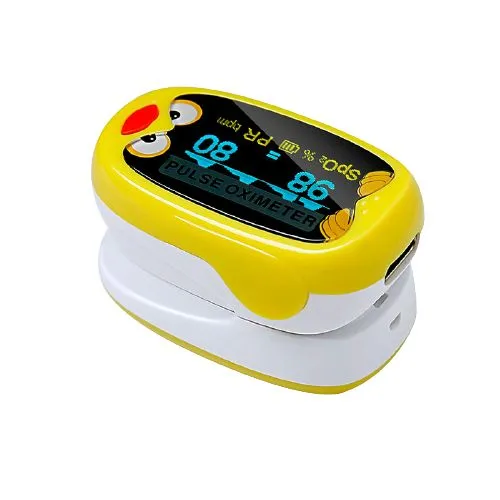
A paediatric fingertip pulse oximeter is a compact digital device designed to measure blood oxygen saturation (SpO₂) and pulse rate through a child’s finger. A fingertip pulse oximeter for children can be useful for routine monitoring at home, in paediatric clinics, hospitals and other healthcare settings where a suitably sized sensor is available.
A pediatric pulse oximeter is designed around the smaller fingers of children. The fingertip sensor uses optical measurement to estimate oxygen saturation and pulse rate without needles or blood sampling.
Because children have smaller fingers than adults, it is important to choose a device or sensor that is appropriate for the intended child's age and finger size. A standard adult fingertip oximeter may not fit properly on a young child's finger.
A fingertip pulse oximeter for children provides a convenient way to obtain an SpO₂ and pulse-rate reading when the device fits the child correctly and the child remains reasonably still during measurement.
Typical features of paediatric fingertip models may include:
Compact child-sized fingertip design
Digital display for SpO₂ and pulse rate
Simple one-button operation
Lightweight and portable construction
Child-friendly designs on some models
Battery-powered or rechargeable options, depending on model
Some models display a pulse waveform or perfusion indicator
Suitable for home-care or clinical monitoring, depending on the specific model
Some currently listed Kenyan models are rechargeable and include features such as OLED displays, Type-C charging and automatic display rotation. These features vary by model, so the exact product specification should be confirmed before purchase.
The device measures oxygen saturation (SpO₂) and pulse rate using light-based sensing at the fingertip. The displayed reading can provide useful monitoring information, but a pulse oximeter should not be used as a substitute for clinical assessment or diagnosis.
For children who are unwell, readings should be interpreted together with symptoms and other clinical information. Seek medical attention when a child has concerning symptoms such as difficulty breathing, severe weakness, bluish discoloration or other signs of serious illness.
Paediatric models are intended to accommodate smaller fingers than many standard adult fingertip oximeters.
The device can display estimated oxygen saturation and pulse rate on a digital screen.
A compact fingertip design makes the oximeter convenient for home care, paediatric clinics and mobile medical kits.
Many fingertip models use simple one-button controls, making routine readings straightforward.
Depending on the model, the display may show SpO₂, pulse rate, pulse waveform and other indicators.
Power arrangements differ between models. Some children's pulse oximeters use replaceable batteries, while rechargeable versions are also available in Kenya.
A suitably sized paediatric pulse oximeter may be used for monitoring children in:
Homes and home-care settings
Paediatric clinics
Hospitals and healthcare facilities
Emergency-care environments
Medical assessment and observation areas
Child respiratory monitoring
The appropriate device depends on the child's age, finger size and the manufacturer's specified intended use. Do not assume that a fingertip model marketed for children is suitable for newborns or very small infants unless the manufacturer specifically states so.
Make sure the child is relatively still and comfortable.
Turn on the pulse oximeter.
Place the child's finger into the sensor according to the manufacturer's instructions.
Ensure the sensor fits securely without excessive pressure.
Wait for the reading to stabilize.
Read the displayed SpO₂ and pulse rate.
Remove the device after use and clean it according to the manufacturer's instructions.
Movement, cold fingers, poor circulation, incorrect sensor positioning and other factors can affect pulse-oximeter readings. If a reading appears unexpected, repeat the measurement correctly and consider the child's overall condition rather than relying on one number alone.
The paediatric pulse oximeter price in Kenya varies according to the model, sensor design, display, battery type, brand and included accessories.
Current Kenyan online listings provide examples such as:
KSh 1,499 for a generic paediatric fingertip pulse oximeter listing.
KSh 1,500 for a paediatric pulse oximeter listed by a Nairobi medical-supplies retailer.
KSh 2,000 for a rechargeable paediatric fingertip pulse oximeter.
KSh 3,500 for an A1 rechargeable children's fingertip pulse oximeter.
These are supplier-specific current listing examples, not a universal market price. Prices and availability can change.
When choosing a children’s pulse oximeter, check:
Recommended age range
Finger-size compatibility
SpO₂ and pulse-rate measurement
Display readability
Battery or rechargeable power
Sensor construction
Included accessories
Manufacturer's intended use
Warranty or supplier support where applicable
For very young children and infants, confirm the sensor size and intended age range before purchasing. A device designed for older children may not provide a suitable fit for a very small finger.
Note: Exact measurement ranges, accuracy, battery capacity, dimensions and included accessories are model-dependent and should be confirmed against the specific product supplied.
A paediatric fingertip pulse oximeter is a small digital device used to measure estimated blood oxygen saturation and pulse rate through a child's fingertip.
The main difference is often the sensor and finger-size suitability. Children's fingers are smaller, so a paediatric model may provide a more appropriate fit than a standard adult fingertip oximeter.
Not necessarily. Some products are designed for children while others may specifically support infants or neonatal use. Always check the manufacturer's stated age range and sensor specifications before using one on an infant.
Current Kenyan listings checked for this product category range from about KSh 1,499 to KSh 3,500 for several paediatric fingertip models, although prices vary by supplier and specification.
It commonly measures estimated peripheral oxygen saturation (SpO₂) and pulse rate.
A pulse oximeter provides physiological measurements but should not be treated as a standalone diagnostic tool. Readings should be interpreted in the context of the child's symptoms and, where appropriate, by a healthcare professional.
Movement can interfere with the measurement. For a more stable reading, keep the child's hand still and allow the displayed values to stabilize.
These other products might interest you
Allow the use of cookies from this website on this browser?
We use cookies to provide improved experience on this website. You can learn more about our cookies and how we use them in our Cookie Policy.