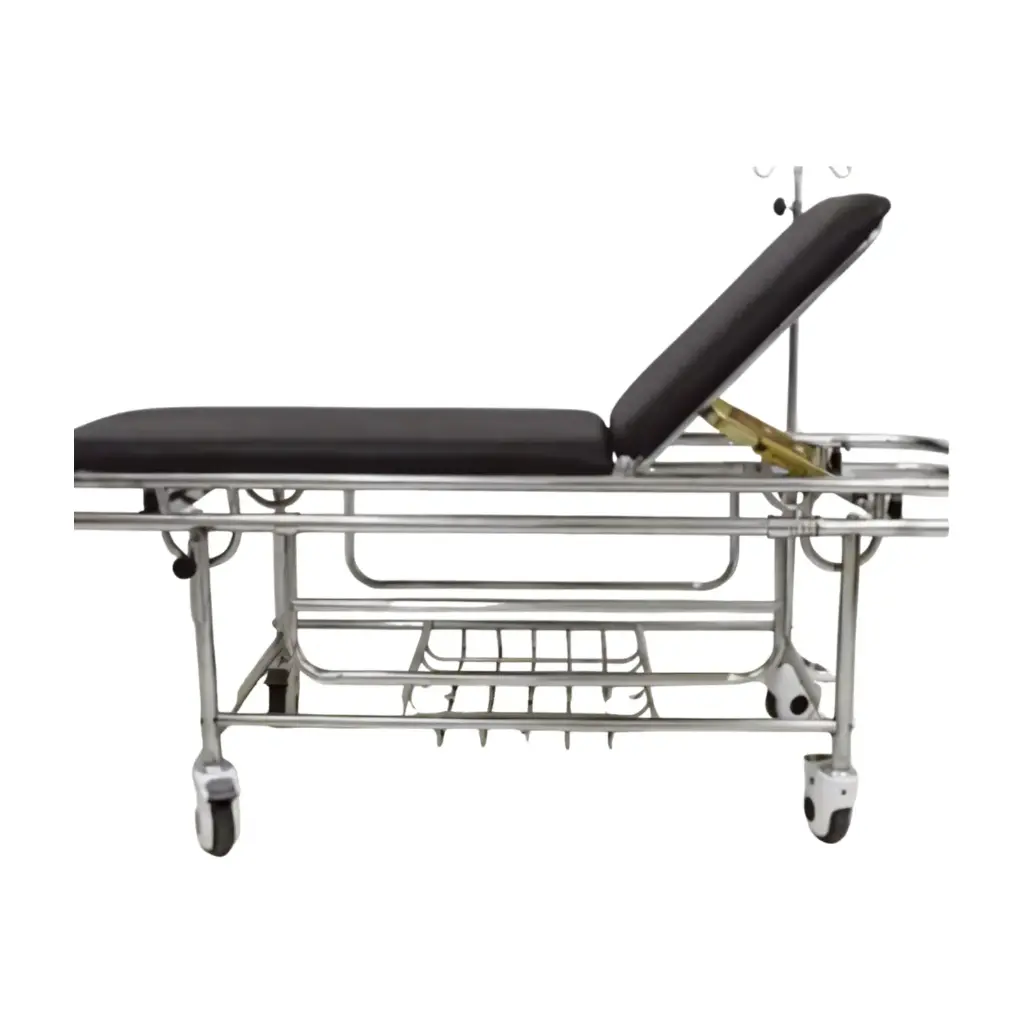
A patient trolley is a mobile hospital transport unit designed to move patients safely between departments, treatment areas, wards, theatres, emergency units, and other healthcare facilities.
Patient trolleys are also commonly called patient transfer trolleys, patient stretcher trolleys, or hospital stretchers. Depending on the model, they may include adjustable height, a backrest, side rails, braking castors, an IV pole, mattress platform, or other patient-transport accessories.
The appropriate trolley depends on whether it is intended for routine movement within a hospital, emergency transfer, theatre use, or more demanding patient-transfer applications.
The price of a patient trolley in Kenya varies considerably according to construction, adjustment mechanisms, accessories, and intended clinical application.
Current Kenya listings provide the following examples:
These are current listing examples rather than a fixed nationwide market price. The large variation reflects differences between basic transport stretchers and higher-specification transfer trolleys with height adjustment, side rails, central locking, mattresses, and other features.
If you want to buy a patient trolley in Nairobi, compare the trolley according to its intended use rather than choosing on price alone.
For routine movement between hospital departments, a standard patient stretcher trolley may be sufficient. Emergency departments may require a trolley with secure side rails, reliable braking, and easy manoeuvrability. Higher-acuity environments may require an adjustable-height or more advanced patient transfer trolley.
Nairobi suppliers and medical-equipment dealers offer different trolley configurations, so buyers should confirm availability, specifications, delivery arrangements, warranty, and after-sales support before ordering.
A patient transfer trolley for sale in Kenya is designed to make movement of patients easier for healthcare staff while providing a stable platform for the patient.
Depending on the model, features may include:
Adjustable height
Adjustable backrest
Side rails
Central-locking castors
Directional castor
Patient mattress
IV pole
Oxygen-cylinder holder
Stainless steel or coated metal frame
ABS patient platform
Foot-operated or manual adjustment
Heavy-duty castor wheels
For example, one current manual patient transfer trolley listing specifies a 1970 × 640 mm platform, height adjustment from 56–86 cm, back adjustment from 0–60°, 180 kg loading capacity, central-lock castors, detachable ABS side rails, mattress, and IV pole. These specifications are model-specific and should not be assumed for every patient trolley.
A patient stretcher trolley in Kenya provides a mobile platform for transporting patients while lying down.
It can be used in:
Hospitals
Clinics
Emergency departments
Outpatient departments
Operating theatres
Recovery rooms
Intensive care areas
Maternity departments
Diagnostic departments
Ambulance receiving areas
A current Kenya listing for a patient delivery stretcher is priced at KSh 40,000 and specifies adjustable side rails and smooth-rolling castors for internal patient movement. Another stainless steel patient stretcher trolley is listed at KSh 42,000.
An emergency patient trolley is intended for rapid movement of patients in emergency and acute-care environments.
The trolley should provide a stable patient platform and allow healthcare staff to manoeuvre the patient efficiently through corridors and treatment areas.
A current Nairobi listing for an Emergency Patient Stretcher Trolley shows a price of KSh 85,000, reduced from a listed KSh 90,000.
Emergency-use models may have additional features compared with basic transport stretchers. Depending on the model, these can include:
Central braking
Directional steering
Mattress
Heavy-duty castors
Always confirm the actual configuration of the model being purchased.
When selecting a hospital patient trolley supplier in Kenya, healthcare facilities should consider more than the initial purchase price.
Important factors include:
Product specifications
Maximum safe working load
Frame construction
Castor size and braking system
Side-rail design
Height adjustment
Backrest adjustment
Mattress specification
Availability of replacement parts
Warranty
Delivery and assembly
Technical support
Intended clinical application
For institutional procurement, it is useful to request a formal quotation specifying the exact trolley model, accessories, warranty, delivery terms, and applicable taxes.
A stainless steel patient trolley may be preferred in healthcare environments where easy cleaning and corrosion resistance are important.
One current Kenya listing describes its patient stretcher trolley as being made from high-quality stainless steel and equipped with side rails and a drip attachment.
When comparing stainless steel models, confirm the actual grade and construction rather than assuming that every trolley marketed as stainless steel uses the same material throughout.
Side rails provide a physical barrier along the sides of the patient platform during transportation.
They can be particularly useful when moving patients through corridors, lifts, treatment areas, and other parts of a healthcare facility.
Depending on the model, side rails may be:
Fixed
Foldable
Collapsible
Detachable
ABS
Metal
Before purchase, confirm that the rails lock securely in the intended position and that their operation does not interfere with patient transfer.
An adjustable patient transfer trolley can provide additional flexibility for transferring patients between beds, examination areas, operating theatres, and other clinical locations.
Higher-specification models may provide:
Trendelenburg or other positioning functions
Integrated accessories
The exact functions vary significantly between models. For example, a manual transfer trolley currently listed in Kenya has height adjustment from 56 to 86 cm and backrest adjustment from 0 to 60°.
Castor wheels allow the trolley to be moved around the healthcare facility.
A good hospital transport trolley should have a braking system appropriate to its design. Some models use central-locking castors, while others use individual wheel brakes.
When comparing patient trolleys with wheels, consider:
Castor diameter
Swivel capability
Directional locking
Wheel quality
Floor compatibility
Manoeuvrability
Maximum load rating
Brakes should be engaged whenever the trolley is parked or when the patient is being transferred on or off the trolley, according to the manufacturer's instructions.
Patient trolleys are used across different areas of a hospital.
Emergency departments may use stretcher trolleys to move patients from reception or casualty areas to examination and treatment spaces.
Trolleys can be used to move patients to and from operating and recovery areas.
More advanced patient transfer trolleys may be appropriate for moving patients who require attached clinical equipment.
Patient stretchers can assist with movement between maternity assessment, labour, delivery, and recovery areas where appropriate.
Trolleys may be used when patients need assistance moving between wards and imaging or diagnostic departments.
A manual patient transfer trolley uses mechanical adjustment rather than electric motors.
One current Kenya listing is priced at KSh 185,000 and includes manual height adjustment, adjustable back section, central-lock castors, ABS detachable side rails, a mattress, and an IV drip pole.
Manual models can be useful where a facility prefers mechanically operated equipment or where electrical adjustment is not required.
A patient trolley and examination couch serve different primary purposes.
If the facility needs to transport patients between departments, a patient trolley is generally more appropriate than a stationary examination couch.
Before buying a patient trolley in Kenya, consider:
Determine whether the trolley is for routine hospital transport, emergency use, theatre transfer, maternity, recovery, or another application.
Check the manufacturer's stated maximum patient load. Do not rely on appearance or frame size to determine capacity.
Adjustable-height models can make transfers and clinical positioning easier, but they generally cost more than basic fixed-height stretchers.
Confirm whether the trolley has fixed, collapsible, or detachable side rails.
Check whether the trolley has central locking, individual brakes, or another braking configuration.
Confirm whether a mattress is included and whether its dimensions and material are suitable for the trolley.
Depending on the intended application, you may require an IV pole, oxygen-cylinder holder, or other accessories.
Select surfaces and materials that can be cleaned according to your facility's infection-prevention procedures and the manufacturer's instructions.
For hospital procurement, confirm warranty terms, spare-parts availability, delivery, assembly, and technical support.
Only trained healthcare staff should operate a patient trolley.
A general workflow is:
Inspect the trolley before use.
Check the castors and braking system.
Ensure the mattress and patient platform are secure.
Position the trolley appropriately beside the patient.
Engage the brakes before transferring the patient onto the trolley.
Transfer and position the patient according to the applicable clinical procedure.
Secure the side rails where required.
Confirm that attached equipment such as IV lines or oxygen tubing has adequate slack and is safely positioned.
Release the brakes before moving the trolley.
Move the patient carefully and avoid unnecessary sudden stops.
Engage the brakes again when the trolley reaches the destination.
Clean the trolley according to the facility's infection-control procedure.
The manufacturer's instructions should always take precedence over this general guidance.
Regular inspection can help identify problems before the trolley is used for patient transport.
Check:
Castor wheels
Brakes
Mattress condition
Frame and joints
Height-adjustment mechanism
Backrest mechanism
Fasteners and fittings
Any trolley showing structural damage, faulty brakes, unstable wheels, or malfunctioning adjustment mechanisms should be removed from service until appropriately inspected and repaired.
Current Kenya listings range from approximately KSh 37,000 for a basic patient stretcher trolley to KSh 185,000 for a higher-specification manual patient transfer trolley. Other current examples include KSh 40,000, KSh 42,000, KSh 45,000–120,000, KSh 85,000, and KSh 120,000 depending on model and features.
Patient trolleys are available from medical-equipment suppliers in Nairobi. Before ordering, confirm the exact model, price, stock status, warranty, accessories, and delivery arrangements.
A patient transfer trolley is a mobile stretcher designed to move patients between different areas of a healthcare facility. Depending on the model, it may have adjustable height, side rails, braking castors, an adjustable backrest, and accessories.
The terms are often used interchangeably. A patient stretcher trolley generally refers to a wheeled platform for transporting patients in a lying position, while “patient trolley” can also describe more advanced adjustable transfer systems.
A current Kenya listing for an emergency patient stretcher trolley is KSh 85,000. Other emergency and patient-transfer trolley prices vary according to design and features.
Some models include a mattress, while others may be supplied without one. The current manual patient transfer trolley listed by Medistus, for example, includes a mattress and IV drip pole.
Many patient stretcher trolleys have side rails, but the design varies. Current Kenya listings include models with adjustable or detachable side rails.
Choose a trolley according to the manufacturer's stated safe working load and the patient population for which it is intended. For example, one current manual transfer trolley specifies a loading capacity of 180 kg.
Not every patient trolley is designed for ambulance use. A standard hospital delivery stretcher may be intended for movement within a facility, while an ambulance stretcher is designed specifically for vehicle transport. Confirm compatibility with the intended ambulance before purchase.
Specifications should be confirmed against the exact trolley model and supplier quotation before purchase.
When requesting a quotation for a patient trolley in Kenya, provide:
Required trolley type
Intended clinical department
Preferred construction
Required patient load capacity
Height adjustment requirement
Backrest requirement
Side-rail requirement
Mattress requirement
IV pole requirement
Oxygen-cylinder holder requirement
Quantity required
Delivery location
Warranty requirements
For hospitals and larger healthcare facilities, requesting a formal quotation with the complete specification helps prevent receiving a trolley with fewer features than required.
These other products might interest you
Allow the use of cookies from this website on this browser?
We use cookies to provide improved experience on this website. You can learn more about our cookies and how we use them in our Cookie Policy.