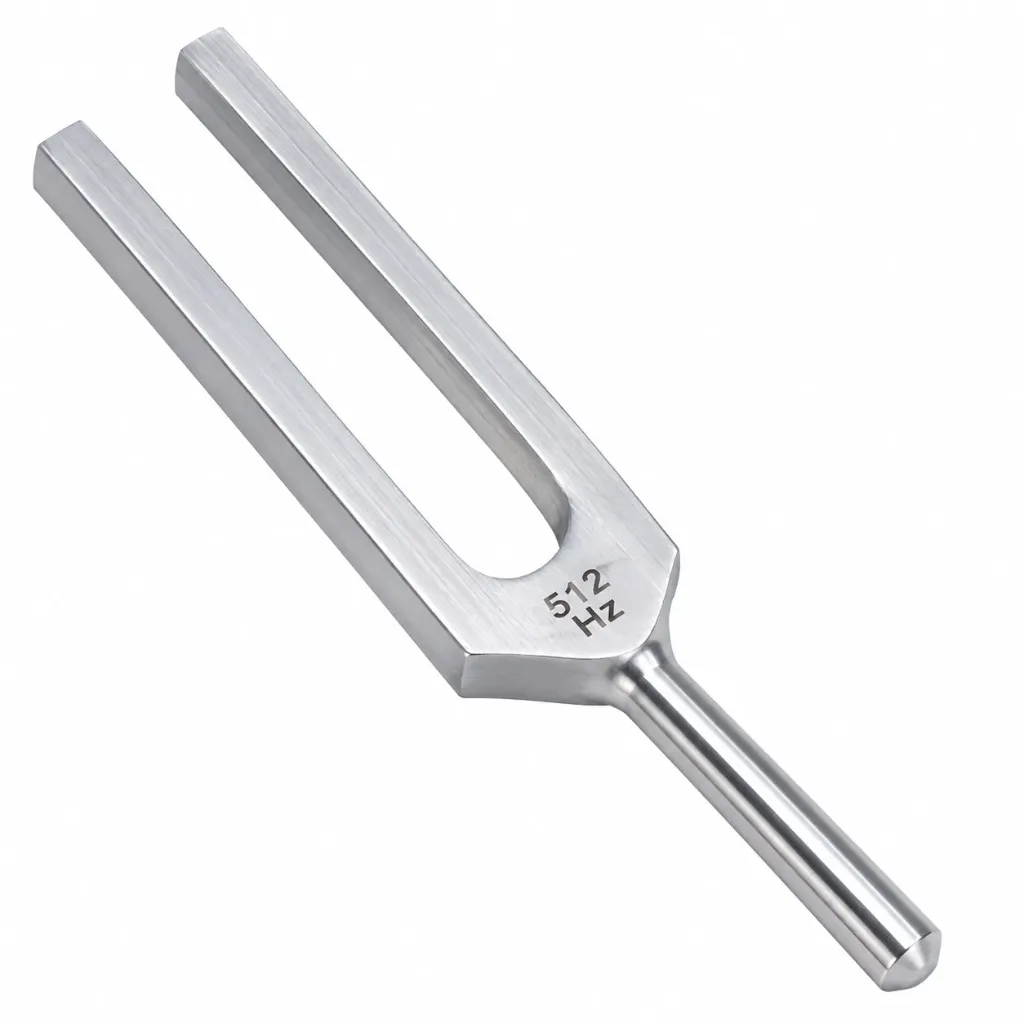
A Tuning Fork 512Hz is a handheld medical diagnostic instrument designed to produce a consistent audible tone at a frequency of approximately 512 hertz when activated. It is primarily used by qualified healthcare professionals to perform bedside hearing assessments, particularly the Rinne and Weber tests, which help distinguish patterns of conductive and sensorineural hearing loss.
Also known as a 512 Hz medical tuning fork, ENT tuning fork, audiological tuning fork, hearing assessment fork, or Rinne and Weber testing fork, this portable instrument is commonly used in hospitals, ENT clinics, audiology departments, general medical consultations, and healthcare training institutions.
A conventional tuning fork consists of two parallel prongs, also called tines, connected to a U-shaped base and a central handle or stem. When the prongs vibrate, they produce a tone corresponding to the instrument's specified frequency.
The 512 Hz frequency is particularly suitable for bedside hearing tests because it provides a practical balance between audible tone duration and relatively limited tactile vibration. Lower-frequency tuning forks, such as 128 Hz, produce stronger tactile vibration and are generally preferred when the objective is to examine vibration sensation during neurological assessment.
The 512 Hz tuning fork is therefore mainly a hearing assessment instrument, although the broader tuning fork family also includes models for neurological examinations.
Medical tuning forks may be manufactured from stainless steel, aluminum, or other manufacturer-specified metal alloys. Some designs include weighted prongs, removable weights, rubber striking accessories, or protective carrying cases.
The tuning fork 512Hz price in Kenya depends on the material, manufacturer, frequency accuracy, construction, included accessories, and whether the product is sold individually or as part of a diagnostic set.
The following publicly advertised prices provide Kenyan market comparisons for 512 Hz tuning forks.
Kenyan Supplier
Product Description
Advertised Price
Equiplex Medical Supplies
Stainless steel tuning fork, 512 Hz
KSh 1,700
Jomex Medical Supplies
Medical tuning fork, 512 Hz
KSh 1,800
Naomi Medispace Medical Supply
KSh 2,000
Jumia Kenya
512 Hz tuning fork with striking hammer
KSh 2,950
These are advertised prices from other suppliers, not Maesio Pharmaceuticals' selling prices. The products differ in construction, accessories, and packaging. Prices and availability may change.
Tuning Fork Type
Main Price Considerations
Standard 512 Hz Tuning Fork
Basic construction and frequency
Stainless Steel 512 Hz Tuning Fork
Steel quality and finishing
Aluminum 512 Hz Tuning Fork
Alloy and manufacturing tolerances
Weighted 512 Hz Tuning Fork
Prong weights and construction
Unweighted 512 Hz Tuning Fork
Standard fork design
512 Hz Tuning Fork With Hammer
Included striking accessory
512 Hz Tuning Fork With Case
Protective packaging
Multi-Frequency Diagnostic Set
Number of forks and included frequencies
Premium Medical Tuning Fork
Manufacturer, frequency tolerance, and quality documentation
Market guidance: The sampled Kenyan listings place standard 512 Hz medical tuning forks around KSh 1,700–2,000, while a set with a striking accessory is advertised at approximately KSh 2,950.
Buy a Tuning Fork 512Hz in Kenya from Maesio Pharmaceuticals Limited for hospitals, ENT clinics, audiology departments, healthcare training institutions, and medical professionals.
Product: Tuning Fork 512Hz – Medical Diagnostic Hearing Test Instrument
Supplier: Maesio Pharmaceuticals Limited
Frequency: 512 Hz
Material: Stainless steel, aluminum, or manufacturer-specified metal alloy; confirm the selected model.
Main Applications: Rinne and Weber bedside hearing tests.
Construction: Two-pronged resonating fork with a central handle.
Accessories: Confirm whether a striking hammer, carrying pouch, or case is included.
Operation: Manual, without batteries or an electrical supply.
Delivery: Nairobi and countrywide Kenya, with East African supply arrangements available by request.
Ordering Advice: Confirm the frequency marking, material, weighted or unweighted design, overall dimensions, accessories, and manufacturer before ordering.
If you are looking to buy 512Hz tuning fork in Nairobi, choosing a properly specified diagnostic instrument is important for reliable bedside hearing assessment.
The 512 Hz tuning fork is frequently selected for clinical examinations because it produces an audible vibration that is suitable for comparing air conduction and bone conduction.
Its compact design makes it convenient for medical consultations, outpatient clinics, and clinical training.
Ear, nose, and throat (ENT) clinics
Audiology departments
General medical wards
Outpatient clinics
Family medicine practices
Primary healthcare facilities
Selected emergency departments
Medical schools
Clinical officer training institutions
Nursing training programs
Diagnostic examination rooms
Specialist hearing assessment facilities
The instrument is intended for clinical assessment by appropriately trained healthcare professionals.
A medical tuning fork for sale in Kenya is available in different frequencies, materials, and designs.
For hearing examinations, the 512 Hz version is a widely recognized clinical choice.
The tuning fork is designed to vibrate at a nominal frequency of 512 Hz.
The two metal tines produce the tone when activated.
The stem allows the clinician to hold the instrument and apply it to the appropriate examination site.
The small, handheld design supports use in clinics and bedside assessments.
Many models use stainless steel or aluminum alloys.
An appropriately maintained tuning fork can be used repeatedly with suitable cleaning procedures.
The fork operates without electrical power or batteries.
Some manufacturers include a pouch or case to protect the instrument during storage.
A tuning fork for hearing test in Kenya is used as part of bedside clinical examinations to assess hearing through air and bone conduction.
Two of the most recognized examinations are the Rinne test and the Weber test.
The Rinne test compares hearing through air conduction with hearing through bone conduction for an individual ear.
The test can help identify a pattern consistent with conductive hearing impairment.
The Weber test assesses whether a vibrating tone is perceived equally in both ears or appears louder in one ear.
This can help a clinician investigate certain patterns of asymmetric hearing loss.
A 512 Hz tuning fork offers useful audible tone duration while limiting the stronger tactile vibration associated with lower-frequency forks.
This makes it a common choice for Rinne and Weber bedside testing.
Important: Rinne and Weber tests are screening and examination tools. They do not replace formal audiometry, tympanometry, otoscopic assessment, or specialist evaluation when these are indicated.
Choosing a reliable neurological tuning fork supplier in Kenya requires distinguishing between instruments intended primarily for hearing assessment and those used for vibration-sensation testing.
Maesio Pharmaceuticals Limited supplies diagnostic instruments, surgical products, hospital equipment, clinical examination supplies, and related healthcare products throughout Kenya and East Africa.
The 512 Hz tuning fork is particularly relevant to ENT and hearing assessment. For conventional peripheral neurological vibration-sense testing, a 128 Hz tuning fork is generally the more appropriate instrument.
Customers can explore diagnostic products and related healthcare supplies through www.maesiopharmaceuticals.co.ke.
Exact 512 Hz frequency
Stainless steel or aluminum-alloy construction
Manufacturer and product model
Weighted or unweighted design
Tine and handle construction
Frequency labeling
Intended clinical application
Protective case availability
Striking accessory inclusion
Cleaning instructions
Packaging quantity
Stock and delivery arrangements
The instrument is designed to produce an audible tone at 512 cycles per second.
Two metal prongs vibrate to generate the sound.
The central handle allows controlled positioning during clinical examinations.
The 512 Hz frequency provides a useful balance of sound duration and limited tactile vibration for bedside hearing tests.
The instrument fits easily into a diagnostic equipment case or examination kit.
Stainless steel and aluminum-alloy models can provide long service when handled and maintained properly.
The tuning fork functions mechanically and does not need batteries.
The instrument can be used repeatedly after suitable cleaning and inspection.
A clinician can use the instrument to gather preliminary information about hearing function.
The 512 Hz tone is widely used for the two established bedside hearing examinations.
Its compact construction makes it convenient for clinics, outpatient departments, and medical training.
Unlike an audiometer, the tuning fork does not require electricity.
The instrument helps students learn about air conduction, bone conduction, and the interpretation of bedside hearing tests.
A well-maintained tuning fork can provide repeated service without disposable test cartridges or batteries.
It may be used alongside otoscopes, audiometers, tympanometers, and other suitable ENT assessment equipment.
Feature
Rinne Test
Weber Test
Primary Assessment
Air vs bone conduction
Perceived sound lateralization
Typical Instrument
512 Hz tuning fork
Examines
Each ear separately
Relative perception between ears
Main Use
Investigating conductive hearing patterns
Investigating asymmetric hearing patterns
Interpretation
Air conduction compared with bone conduction
Sound perceived centrally or lateralized
Limitations
Can produce misleading results in some circumstances
Cannot independently establish a diagnosis
Follow-Up
Further assessment where indicated
The Rinne test compares the patient's perception of a tone transmitted through air with a tone transmitted through bone.
In a typical normal-hearing result, air conduction is perceived longer than bone conduction.
When bone conduction is perceived longer than air conduction, the finding may indicate a conductive hearing loss in that ear.
However, certain conditions, including severe asymmetric sensorineural hearing loss, may produce misleading results. Interpretation must be made in the context of the full examination.
The Weber test evaluates whether the patient perceives a tone equally in both ears or predominantly in one ear.
In some conductive hearing losses, the sound may lateralize toward the affected ear. In some sensorineural hearing losses, the sound may lateralize toward the better-hearing ear.
These are characteristic patterns, not definitive diagnoses.
A 512 Hz tuning fork and a 128 Hz tuning fork are designed for different principal clinical purposes.
512 Hz Tuning Fork
128 Hz Tuning Fork
Nominal Frequency
512 Hz
128 Hz
Main Application
Bedside hearing assessment
Neurological vibration-sense assessment
Common Tests
Rinne and Weber
Peripheral vibration-sensation testing
Audible Tone
Higher pitch
Lower pitch
Tactile Vibration
Less prominent
More prominent
ENT Use
Commonly preferred
Less suitable for standard hearing comparisons
Neurological Examination
Not first choice for vibration sense
Operating Principle
Mechanical resonance
For conventional testing of vibration sensation, 128 Hz is generally preferred because the lower frequency produces a more readily perceived tactile vibration.
A 512 Hz tuning fork may have limited supplementary uses, but it should not automatically be substituted for the 128 Hz neurological examination fork.
This distinction matters when hospitals, medical students, and clinicians purchase diagnostic equipment.
256 Hz
1024 Hz
Pitch
Lower
Medium
Higher
More noticeable
Less noticeable
Usually less noticeable
Tone Decay
Generally slower
Balanced
Often faster
Bedside Rinne / Weber
Alternative in some settings
Less commonly selected
Neurological Vibration Sense
May be used
Not preferred
A 512 Hz fork is a practical default for standard bedside hearing comparisons. The clinician should still consider the quality of the instrument and the limitations of the examination.
Stainless Steel Tuning Fork
Aluminum Tuning Fork
Material
Steel alloy
Aluminum alloy
Weight
Model dependent
Often lighter
Corrosion Resistance
Grade dependent
Alloy and finish dependent
Resonance
Design dependent
Surface Finish
Polished or matte
Manufacturer dependent
Cleaning
Material-compatible products
Durability
Manufacturing dependent
Diagnostic Suitability
Requires appropriate frequency design
Neither material automatically guarantees superior hearing-test performance. Frequency stability and instrument construction should be verified against the manufacturer's specifications.
A weighted fork may feature additional masses on the prongs to modify vibration behavior.
An unweighted fork uses a more conventional tine construction without additional adjustable masses.
The appropriate design depends on the intended clinical test and the manufacturer's specifications.
When purchasing a 512 Hz hearing-test fork, choose a model intended for medical audiological examination rather than assuming all tuning forks with the same nominal frequency are interchangeable.
Audiometer
Technology
Mechanical
Electronic
Frequency
Primarily 512 Hz
Multiple test frequencies
Clinical Purpose
Comprehensive hearing threshold testing
Hearing Threshold Measurement
Not quantified in decibels
Yes, with suitable equipment and procedure
Portability
Highly portable
Depends on model
Power
None
Generally required
Clinical Role
Screening and preliminary assessment
Formal audiometric evaluation
Interchangeability
No
A tuning fork cannot provide a complete audiogram, quantify hearing thresholds, or replace a properly conducted audiological assessment.
ENT professionals may use the tuning fork during the assessment of patients who report hearing changes, blocked-ear sensations, or other symptoms requiring clinical evaluation.
The instrument assists in preliminary assessment of air and bone conduction.
The Weber test can provide information about lateralization.
Results may help determine whether further audiometry or specialist testing is required.
Findings may be recorded as part of a patient's clinical examination.
Sudden hearing loss should be treated as a potentially urgent medical issue and should not be managed solely on the basis of tuning fork testing.
A 512 Hz tuning fork is a useful addition to medical and clinical examination training equipment.
ENT examination practice
Rinne test demonstrations
Weber test demonstrations
Understanding air conduction
Understanding bone conduction
Learning the limitations of bedside hearing tests
Practicing patient communication during examination
Check whether the institution specifically requires a 512 Hz fork. Some programs also require a separate 128 Hz tuning fork for neurological assessment.
Before purchasing, consider:
Frequency: Confirm a clearly marked 512 Hz rating.
Intended use: Verify suitability for hearing examinations.
Material: Confirm stainless steel, aluminum, or another specified alloy.
Design: Check weighted or unweighted construction.
Prongs: Inspect for symmetrical, undamaged tines.
Stem: Verify secure handle construction.
Resonance: Request the manufacturer's frequency specification.
Accessories: Confirm any striking hammer or storage case.
Cleaning: Check approved cleaning procedures.
Manufacturer: Obtain brand and model information.
Packaging: Verify the items included.
Institutional use: Match the required examination equipment list.
Bulk orders: Confirm quantities.
Delivery: Verify shipping arrangements.
A qualified healthcare professional activates the fork using an appropriate striking method and positions it according to the intended Rinne or Weber examination protocol.
The clinician observes and interprets the patient's reported perception of the tone.
Testing should be carried out in a reasonably quiet environment using an undamaged, correctly specified instrument.
Incorrect activation, striking the fork against a very hard surface, or using inappropriate positioning may affect the examination.
The test should be interpreted alongside the patient's history, otoscopic findings, and any required formal hearing tests.
A tuning fork is reusable clinical equipment that requires regular inspection and appropriate cleaning.
Follow the manufacturer's cleaning instructions.
Wipe the instrument with a compatible cleaning product.
Pay attention to the handle and patient-contact surfaces.
Avoid prolonged immersion unless expressly approved.
Dry the instrument appropriately.
Store it in a clean, dry place.
Check for:
Bent or misaligned tines
Cracks or visible metal damage
Loose components
Corrosion or pitting
Damaged frequency markings
Unusual buzzing or distorted resonance
Damage following a fall or strong impact
A tuning fork may become unsuitable for reliable clinical testing if damaged or modified.
If its frequency performance is in doubt, remove it from diagnostic service and follow the manufacturer's inspection or replacement guidance.
Do not assume that a tuning fork is autoclavable. Use only the cleaning or sterilization methods specifically approved by the manufacturer.
Keep the fork in a protective case or dedicated diagnostic tray to reduce the risk of impact damage.
Comparable 512 Hz medical tuning forks are advertised by Kenyan suppliers at approximately KSh 1,700–2,000. A model supplied with a striking hammer is listed at approximately KSh 2,950. These are competitor prices, not Maesio prices.
You can inquire through Maesio Pharmaceuticals Limited for 512 Hz tuning forks and related medical diagnostic equipment.
It is a metal diagnostic instrument designed to produce a tone at approximately 512 vibrations per second.
Its primary clinical applications are the Rinne and Weber bedside hearing tests.
Yes. Kenyan medical equipment suppliers advertise diagnostic tuning forks at 128 Hz, 256 Hz, and 512 Hz, among other frequencies.
It provides a useful balance of tone duration and limited tactile vibration for hearing comparisons.
Yes. The 512 Hz tuning fork is a standard choice for the Rinne hearing test.
Yes. It is commonly used for Weber hearing assessments.
It compares the patient's perception of sound through air conduction and bone conduction.
It evaluates whether a tone is perceived equally in both ears or lateralizes toward one ear.
It can provide preliminary clinical findings, but it cannot independently establish a complete diagnosis or replace audiometry.
It is not the preferred frequency for routine vibration-sensation testing. A 128 Hz fork is more commonly used for that purpose.
The 128 Hz fork is commonly used for neurological vibration-sense testing, while the 512 Hz fork is mainly used for bedside hearing assessments.
Rinne and Weber patterns may help clinicians investigate sensorineural hearing loss, but further examination is often necessary.
Appropriately performed bedside tests may provide findings suggestive of conductive hearing loss.
Yes. Stainless steel models are available in Kenya.
Yes. Some manufacturers produce tuning forks from aluminum alloys.
No. A conventional mechanical tuning fork does not require batteries or electricity.
Yes. Different manufacturers offer weighted and unweighted configurations.
Some packages include a striking accessory, while others supply only the tuning fork.
This depends on the manufacturer and package configuration.
Yes. It is commonly used in medical examination teaching and supervised clinical training.
Yes. It is a useful instrument for preliminary bedside hearing assessment.
Yes. Appropriately trained practitioners may use them during clinical examinations.
No. A tuning fork provides qualitative bedside findings, while audiometry assesses hearing thresholds across multiple frequencies.
Yes. Results may be affected by instrument quality, technique, hearing impairment severity, environmental noise, and patient responses.
Use manufacturer-approved cleaning products and follow the healthcare facility's infection-prevention procedures.
Only if the manufacturer expressly approves steam sterilization for the selected model.
Physical damage, bending, or modification can affect its vibration characteristics.
Yes. Conventional diagnostic tuning forks are reusable when maintained appropriately.
It should be inspected for damage. A deformed or unusually sounding fork should not be relied upon until its suitability is confirmed.
Yes. Hospitals, clinics, and medical training institutions can request institutional quotations.
Yes. Medical diagnostic sets may include different frequencies for hearing and neurological assessments.
Maesio Pharmaceuticals supplies customers throughout Kenya and can arrange deliveries to East African destinations.
Confirm the 512 Hz frequency, material, intended examination use, manufacturer, weighted or unweighted design, accessories, packaging, and availability.
Specification
Details
Product Name
Tuning Fork 512Hz
Alternative Names
512 Hz Medical Tuning Fork, ENT Tuning Fork, Hearing Test Tuning Fork, Rinne and Weber Tuning Fork
Product Category
Diagnostic Instruments / ENT Equipment / Medical Examination Tools
Product Type
Mechanical acoustic diagnostic instrument
Frequency Unit
Hertz (cycles per second)
Main Clinical Application
Secondary Examination Use
According to clinician and device instructions
Preferred for Neurological Vibration Sense
No; 128 Hz is generally preferred
Main Material
Stainless steel, aluminum alloy, or manufacturer-specified metal
Exact Material
Confirm selected model
Instrument Design
U-shaped resonating fork with two tines
Number of Prongs
Two
Handle
Central stem
Weighted Prongs
Unweighted Design
Available
Frequency Tolerance
Confirm manufacturer's specification
Tone Duration
Overall Length
Prong Length
Instrument Weight
Polished or manufacturer-specified finish
Frequency Marking
Striking Hammer
Optional; confirm package
Protective Pouch
Optional
Storage Case
Battery Required
Electrical Requirement
Digital Display
Not applicable
Calibration Certificate
Not assumed
Manufacturer-approved methods
Autoclave Compatibility
Reusable
Yes, for conventional models
Disposable
No, unless specifically labeled
Sterile on Supply
Intended Users
Trained healthcare professionals and supervised medical students
Clinical Settings
ENT clinics, hospitals, outpatient departments, audiology services, medical training
Formal Audiometry Replacement
Packaging Quantity
Confirm selected package
Manufacturer
Confirm available model
Country of Manufacture
Confirm supplier documentation
Warranty
Confirm applicable terms
Bulk Procurement
Available by quotation
Stock Availability
Subject to confirmation
Delivery
Nairobi, countrywide Kenya, and East Africa by arrangement
These specifications describe the standard 512 Hz medical tuning fork category. Exact material, dimensions, weights, frequency tolerance, included accessories, and cleaning requirements should be confirmed for the selected Maesio product.
These other products might interest you
Allow the use of cookies from this website on this browser?
We use cookies to provide improved experience on this website. You can learn more about our cookies and how we use them in our Cookie Policy.